


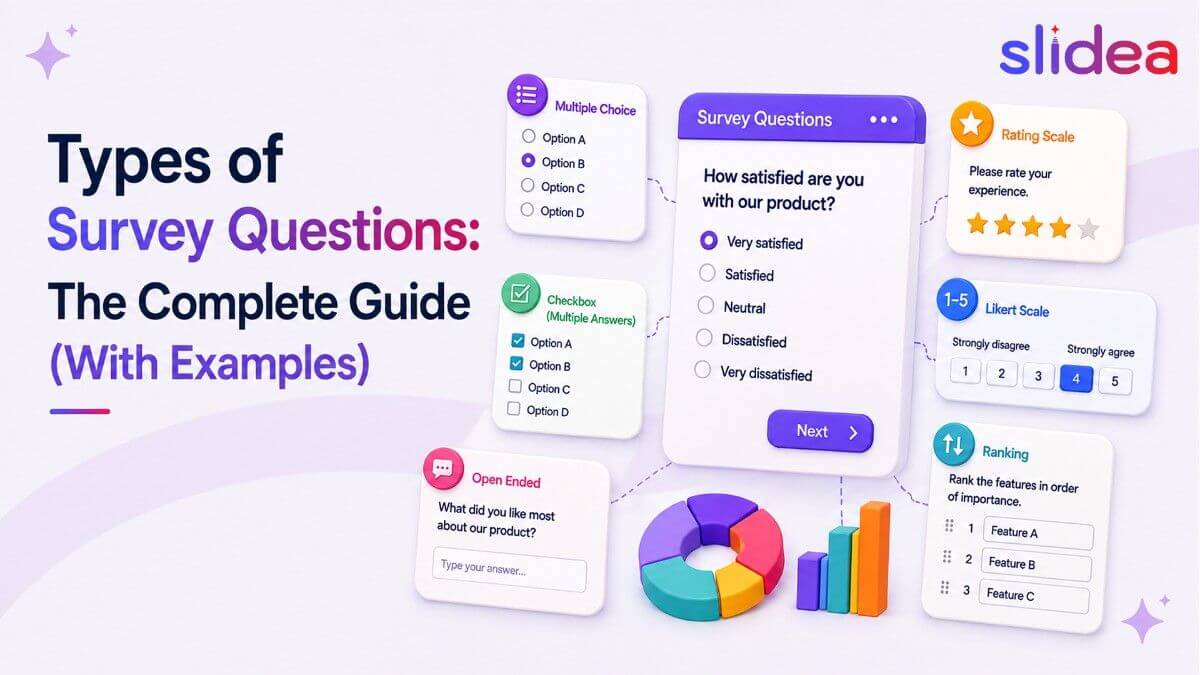
A survey rarely fails loudly. It just quietly produces data nobody can use: forced one-word answers to a question that needed context, or a wall of open text where a single tap would have done the job. Most of that comes down to picking the wrong format for what you're actually trying to learn. There are nine common types of survey questions: multiple choice, Likert scale, rating scale, NPS, ranking, matrix, dichotomous (yes/no), open-ended, and demographic. Each is explained below with a real example, including several built and tested live in Slidea.
On this page
- Closed-ended vs. open-ended: the big split
- Multiple choice questions
- Likert scale questions
- Rating scale and NPS questions
- Ranking questions
- Matrix questions
- Dichotomous (yes/no) questions
- Open-ended questions
- Demographic questions
- How to choose the right type
- FAQs
Closed-Ended vs. Open-Ended: The Big Split
Almost every survey question type falls into one of two families.
Closed-ended questions give respondents a fixed set of answers to pick from: multiple choice, Likert scale, rating, NPS, ranking, matrix, and dichotomous questions all belong here. They're fast to answer and easy to turn into a chart, which is why most of a survey should be built from them.
Open-ended questions let respondents type their own answer in their own words. They take longer to answer and longer to analyze, but they surface the "why" behind a number that a closed question can't explain on its own.
A well-built survey usually leans heavily on closed-ended questions for the bulk of the data, then uses one or two open-ended questions to capture context a multiple-choice list would miss.
Multiple Choice Questions
A multiple choice question offers a short list of answer options, and the respondent picks one (or sometimes several). It's the workhorse of survey design: fast to answer, easy to analyze, and familiar to almost everyone.
For example:
"How do you prefer to give feedback at work?" with the options Anonymous survey, One-on-one conversation, and Team meeting.
Multiple choice works best when you already know the likely range of answers. If you're not sure what the answers might be, an open-ended question or a pilot survey will tell you more than guessing at options.
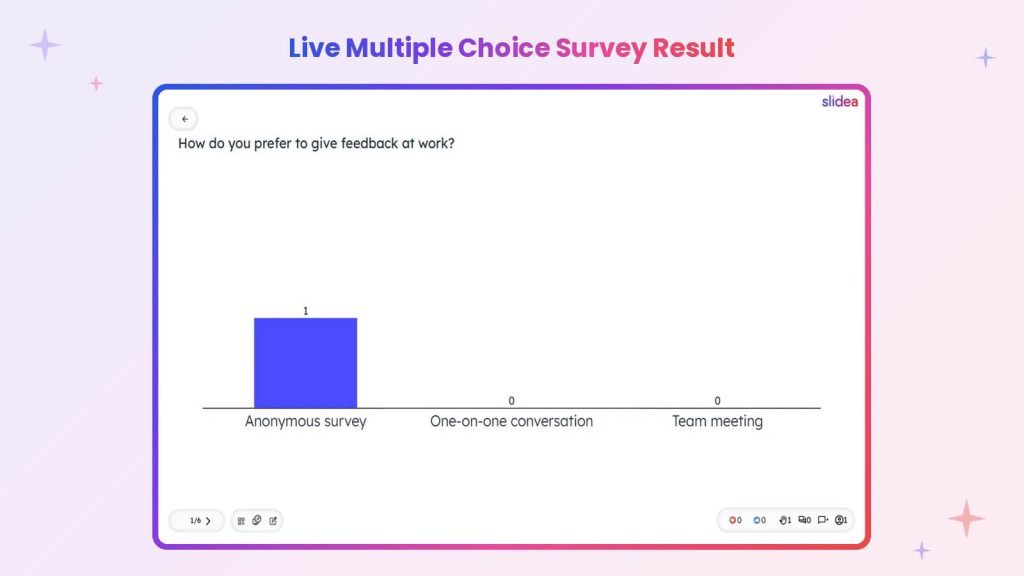
Good multiple choice questions keep options mutually exclusive (a respondent shouldn't be torn between two answers that both apply) and collectively exhaustive (there's a reasonable option for everyone, or an "Other" catch-all). If you want a deeper library of ready-to-use options, Fun Multiple Choice Questions to Test Knowledge has a large set built for classrooms and training sessions alike.
Likert Scale Questions
A Likert scale question asks how much someone agrees or disagrees with a statement, usually on a 5-point scale from "Strongly Disagree" to "Strongly Agree." Unlike a single rating question, Likert scales are typically asked as a batch of related statements, which makes it easy to spot which specific area is weak even when the overall sentiment looks fine.
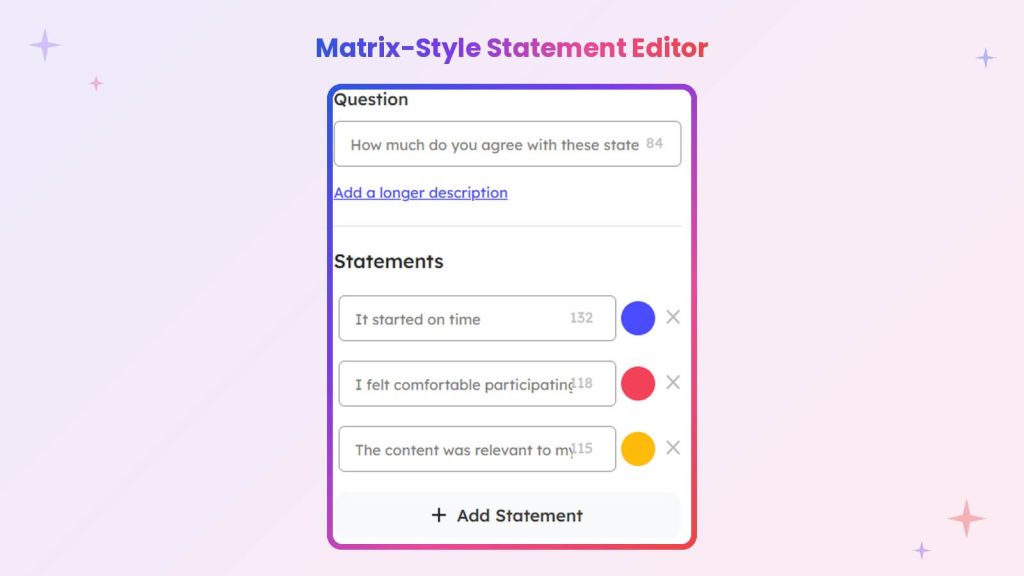
For example, instead of asking "Was today's session good?", a Likert-style question set might ask respondents to rate their agreement with several statements at once:
- It started on time
- I felt comfortable participating
- The content was relevant to my role
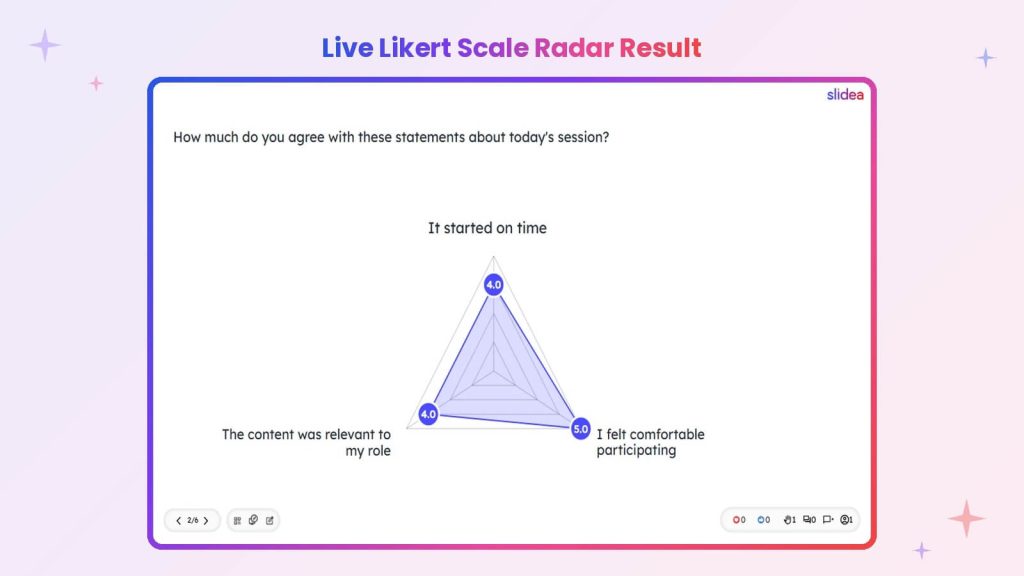
Because Likert questions are so widely used, Slidea's blog has several deep dives already: What Is a Likert Scale? Types & Examples covers the format itself, Best Ways to Phrase Likert Scale Questions Clearly covers wording pitfalls, and Best Likert Scale Examples for Real-Time Feedback has ready-to-use statement sets.
Rating Scale and NPS Questions
A rating scale question asks respondents to rate a single item on a numeric scale, most often 1–5 or 1–10, without the "agree/disagree" statement framing of a Likert question. "Rate your experience from 1 to 5" is a rating scale question. "I felt this experience met my expectations: Strongly Disagree to Strongly Agree" is a Likert question. The two get confused constantly because they often use the same slider, but a rating scale measures a quality directly, while a Likert scale measures agreement with a statement about that quality.
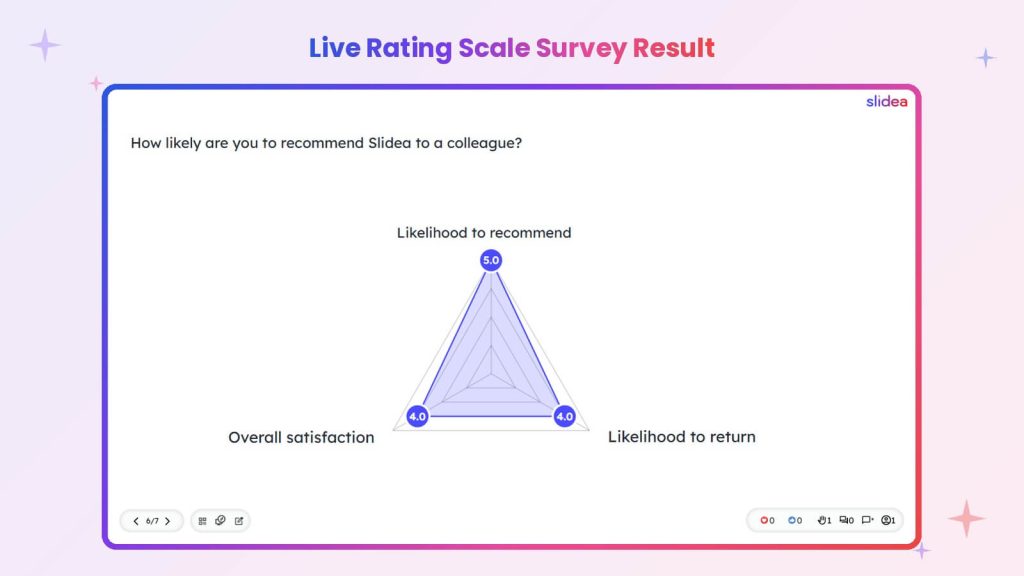
Use a plain rating scale when you want a quick quality signal on one specific thing. Use NPS when you want a standardized loyalty metric you can compare release over release. Use a full Likert battery, like the one above, when you need to know which specific aspect is dragging the average down.
Ranking Questions
A ranking question asks respondents to put a list of items in order, from most to least important, most to least preferred, or first to last in sequence. It's the right choice whenever the order itself is the answer you're after, not just which single option "wins."
For example:
"Rank these onboarding steps in the order new hires should complete them," with options like Set up accounts and tools, Meet the team, and Shadow a live project.
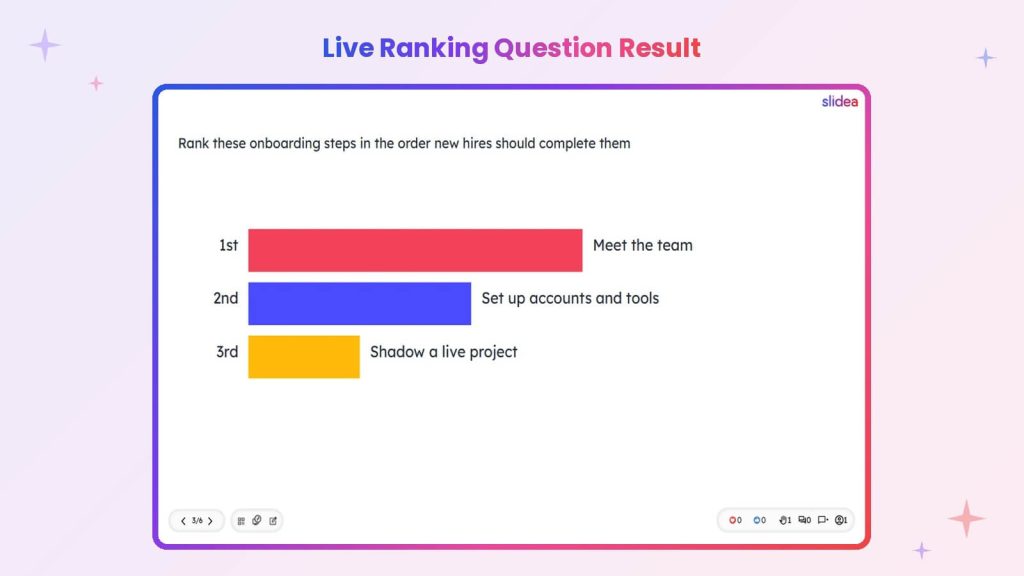
Keep ranking lists short. Ranking more than five or six items becomes tedious on a phone screen, and the bottom of a long list tends to get arranged carelessly just to finish the question.
Matrix Questions
A matrix (or grid) question asks respondents to rate several items against the same set of response options, all in one compact table: rows are the items, columns are the scale. A restaurant survey asking respondents to rate food, service, and cleanliness, each on the same "Poor to Excellent" scale, in a single grid, is a classic matrix question.
Matrix questions are efficient on paper, but they're also where survey fatigue shows up first: respondents start selecting the same column straight down the grid without really reading each row, a pattern researchers call straight-lining. If you're building a matrix question, keep it to five rows or fewer and watch your response times for suspiciously fast completions.
If a matrix question would only cover two or three related statements, Slidea's Scales slide (shown above under Likert scale questions) accomplishes the same goal one statement at a time, with each statement's average shown individually rather than compressed into a grid. Here's what building that multi-statement setup looks like in the editor:
Dichotomous (Yes/No) Questions
A dichotomous question offers exactly two mutually exclusive options, most commonly Yes/No, True/False, or Agree/Disagree. It's the fastest question type to answer and the easiest to analyze, which makes it useful as a screening or branching question: "Have you used this feature before?" before you route respondents into different follow-up questions.
For example:
"Would you recommend this workshop to a colleague?" with Yes or No as the only options.
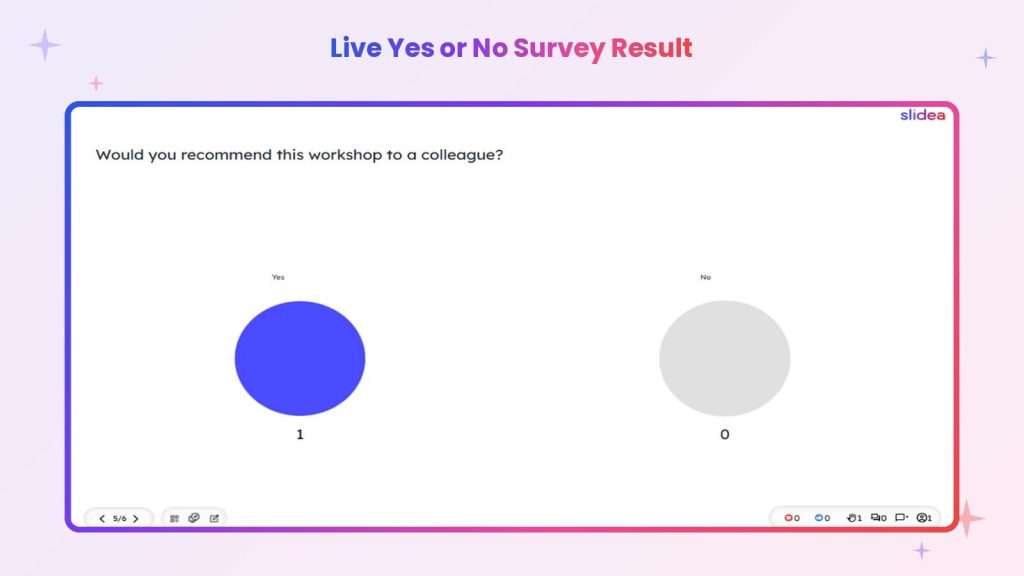
The tradeoff is nuance. A dichotomous question can't capture "mostly yes, with one caveat," so it works best for genuinely binary facts rather than opinions with shades of gray, which are better served by a rating scale or Likert question instead.
Open-Ended Questions
An open-ended question lets respondents answer in their own words instead of picking from a list. It takes longer to answer and longer to read through afterward, but it's the only question type that can surface an issue you didn't think to ask about.
For example:
"What's one thing we could do to make this workshop more useful for you?"
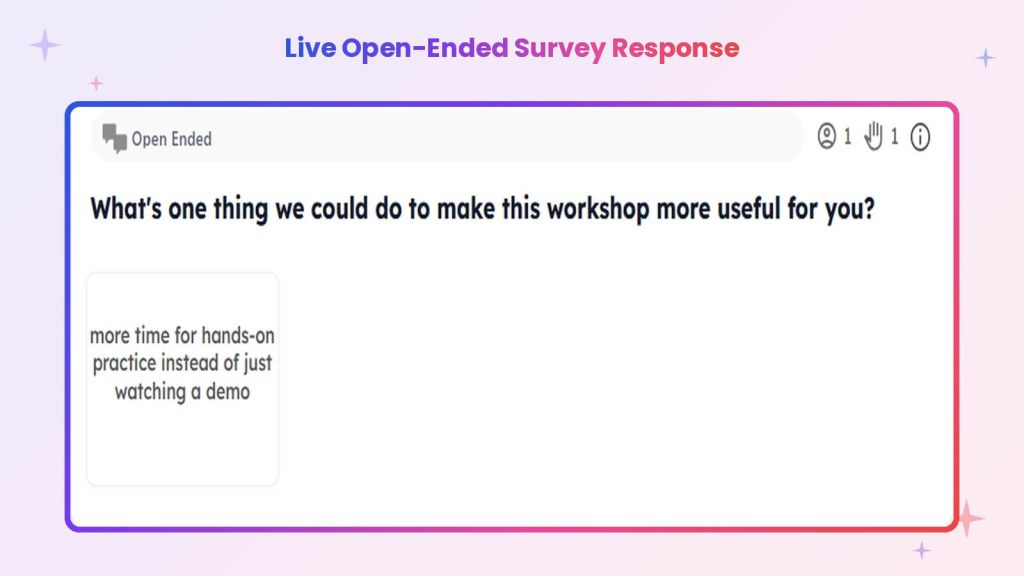
Use open-ended questions sparingly and place them near the end of a survey. Asking for free text early, before a respondent is warmed up, tends to produce short, low-effort answers. Slidea's guides on the format go deeper: Open-Ended Question Definition and Examples and Why and How to Ask Open-Ended Questions.
Demographic Questions
Demographic questions collect background facts about the respondent, like role, department, age range, tenure, or location, so you can segment the rest of the survey's answers by group. "Which department do you work in?" is a demographic question; everything interesting happens when you cross-tabulate it against the satisfaction or Likert questions elsewhere in the survey.
Ask only the demographic fields you'll actually use for segmentation. Every optional field you add is one more reason for a respondent to abandon the survey, and a demographic question that never gets analyzed was a pure cost with no benefit.
How to Choose the Right Type
A quick way to decide: if you can predict the likely answers, use a closed-ended type (multiple choice, Likert, rating, ranking, matrix, or dichotomous). If you genuinely don't know what people will say, or you need the reasoning behind a number, use an open-ended question. If you need to compare results over time or across groups, standardize on rating scale or NPS so the numbers stay comparable survey after survey.
Most real surveys mix several types: a couple of dichotomous screening questions, a Likert battery or two for attitudes, a ranking question for priorities, and one open-ended question at the end to catch anything the closed questions missed. For ready-made question sets across contexts, Survey Questions for Events, Teams & Any Occasion and 40+ Business Survey Questions & Why They Matter are good starting points. If you're deciding between a quick single-question pulse check and a full survey, Poll vs Survey: Key Differences Explained lays out when each makes sense.
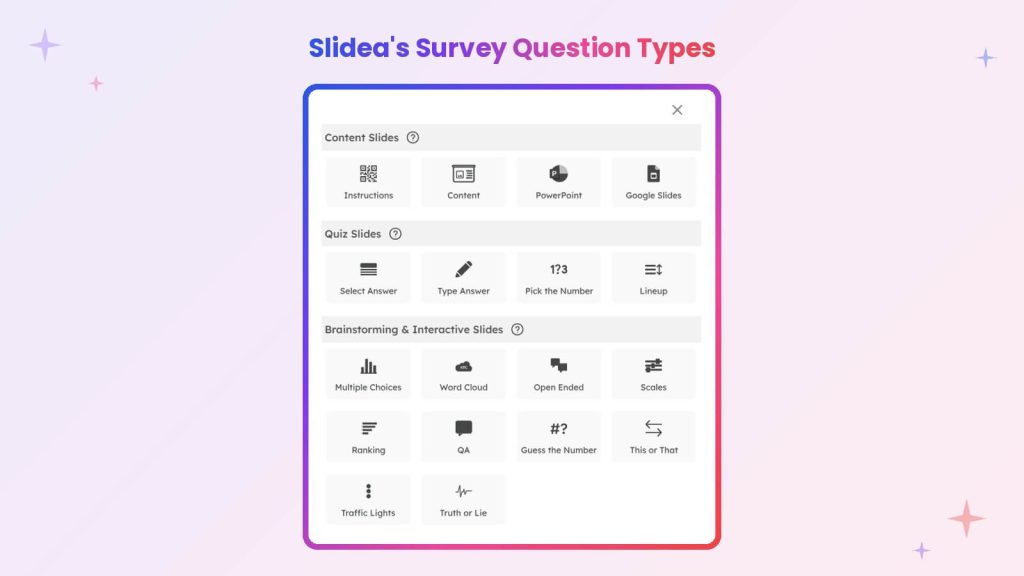
Most of the screenshots in this guide come from a single Slidea presentation, built and run live with a real participant: Multiple Choice, Scales (used for both the Likert battery and the rating scale battery), Ranking, Open Ended, and This or That. The slide-picker and statement-editor screenshots show how those slides get built in the first place rather than a live result. Slidea's Scales tool, on its fixed 1–5 range, is what stands in here for a traditional matrix question and a true 0–10 NPS score.
Frequently Asked Questions
What are the main types of survey questions?
The main types are multiple choice, Likert scale, rating scale, NPS, ranking, matrix, dichotomous (yes/no), open-ended, and demographic. Most surveys combine several of these rather than relying on just one.
What's the difference between closed-ended and open-ended questions?
Closed-ended questions give respondents a fixed set of options to choose from, which makes them fast to answer and easy to analyze. Open-ended questions let respondents answer in their own words, which takes longer but can surface details a fixed list would miss.
When should I use a Likert scale instead of a rating scale?
Use a Likert scale when you're measuring agreement with a specific statement, especially across several related statements at once. Use a plain rating scale when you just need a quick quality score on a single item, without the statement framing.
What is NPS and how is it different from a regular rating question?
NPS (Net Promoter Score) is a standardized 0–10 rating question that asks how likely someone is to recommend something, with respondents grouped into detractors, passives, and promoters. It differs from a generic rating question mainly in its fixed scale and scoring formula, which make it comparable across surveys and over time.
How many questions should a survey have?
There's no fixed number, but shorter is almost always better for completion rates. A tightly scoped survey with 5–10 well-chosen questions, mixing closed-ended types with one open-ended question at the end, usually outperforms a long survey that tries to cover everything at once.
Should survey questions be optional or required?
Make demographic and open-ended questions optional where possible, since forcing an answer on sensitive or effortful questions increases abandonment and can produce low-quality "junk" responses just to get past the question.
What's the best question type for measuring customer satisfaction?
A rating scale or NPS question works well for tracking satisfaction as a single number over time, while a short Likert battery is better when you need to know which specific part of the experience is driving that number up or down.
Can I mix question types in the same survey?
Yes, and most effective surveys do. A common pattern is a dichotomous screening question, a few closed-ended questions for the bulk of the data, and one open-ended question near the end to capture anything the fixed options didn't cover.







Your email address will not be published. Required fields are marked *