


A doctor walks into a room and asks a patient "Are you in pain?" The patient says "Yes." And the conversation stops right there.
Now imagine the doctor asks "Can you describe what you are feeling and where it hurts?" Suddenly the patient opens up, explaining the type of pain, when it started, what makes it worse, and how it affects their daily life. The doctor now has everything they need to actually help.
That is the difference between a closed question and an open-ended question. And that difference changes everything, in medicine, in classrooms, in business meetings, in interviews, and in everyday conversations.
Open-ended questions are one of the most powerful communication tools in the world. They unlock honest answers, spark real conversations, and help people feel genuinely heard. Yet most of us default to closed questions without even realizing it.
In this blog, you will get a clear, simple definition of open-ended questions, real examples across different settings, and practical tips on how to use them well. Plus, a special section on how interactive presentation platforms help you bring open-ended questions to life in front of any audience, in any setting.
What Is an Open-Ended Question?
An open-ended question is a question that cannot be answered with a simple yes, no, or one-word response. It invites the person answering to think, reflect, explain, and share their thoughts in their own words and in their own way.
Open-ended questions usually start with words like: What, How, Why, Tell me, Describe, Explain, In what way, What do you think. These starter words signal to the person that there is no single right answer expected, and that their full, personal response is welcome.
Here is the simplest way to understand it:
A closed question has a door that closes after one answer. An open-ended question has a door that swings wide open and invites a whole conversation to walk through.
Open-Ended vs Closed-Ended Questions
Before going deeper, it helps to see both types side by side so the difference is crystal clear. Here is a simple comparison table that shows exactly how they work and when to use each one.
What Makes Them Different?
| Feature | Closed-Ended Questions | Open-Ended Questions |
| Type of Answer | Fixed, limited answer, yes, no, or one word | Full, personal response in the person’s own words |
| Purpose | Get quick facts, confirm details, check knowledge | Spark discussion, understand feelings, explore ideas |
| Best Used For | Surveys, quizzes, fact-checking, quick decisions | Interviews, feedback, teaching, team discussions |
| Conversation Impact | Ends the conversation after one answer | Opens up the conversation and keeps it going |
| Thinking Required | Little to no deep thinking needed | Requires reflection, reasoning, and personal input |
| Starter Words | Did, Is, Are, Have, How many, When | What, How, Why, Tell me, Describe, Explain |
| Example Question | “Did you finish the report?” Yes or No | “How is the report coming along and what challenges have you run into?” |
When Should You Use Each One?
| Use Closed-Ended Questions When... | Use Open-Ended Questions When... |
| You need a quick, specific answer | You want to understand how someone thinks or feels |
| You are confirming a fact or detail | You want to start or deepen a conversation |
| You are running a quiz or knowledge check | You are gathering genuine feedback or opinions |
| Time is very limited | You want every person to feel heard and included |
| You need a yes or no decision fast | You are teaching, coaching, or facilitating a group |
The key rule is simple: use closed-ended questions when you need a fact quickly. Use open-ended questions when you want to connect, explore ideas, and create meaningful conversations that actually go somewhere.
Real Examples of Open-Ended Questions Across Different Settings
Open-ended questions work in every setting imaginable. Here are real examples across six different areas of life:
In the Classroom:
- "What do you think the author was trying to say in this chapter?"
- "How would you solve this problem differently if you could start over?"
- "What connections do you see between what we learned today and real life?"
- "Why do you think this historical event happened the way it did?"
- "What questions do you still have after today's lesson?"
These classroom open-ended questions push students beyond simple recall. They build critical thinking, encourage students to form opinions, and turn a one-way lesson into a two-way discussion. They also make every student feel like their thinking matters, which is one of the most important things a teacher can create in a classroom.
In Business and the Workplace:
- "What do you think is holding our team back from reaching its full potential?"
- "How would you describe the biggest challenge you face in your role right now?"
- "What does a successful outcome look like to you for this project?"
- "How do you think we could improve the way we communicate across departments?"
- "What would make you feel more supported in your day-to-day work?"
These questions are gold in team meetings, performance reviews, and brainstorming sessions. They give managers real insight into how their team feels. They give employees a genuine voice. And they lead to conversations that actually move things forward, instead of just going through the motions.
In Customer Research and Feedback:
- "What made you decide to choose our product over others?"
- "How has using our service changed the way you work?"
- "What is one thing we could do better that would make the biggest difference to you?"
- "What was your experience like from the moment you first heard about us?"
- "What would you tell a friend who was thinking about trying our service?"
Businesses that ask open-ended feedback questions get answers that actually help them improve. Instead of a star rating with no context, they get stories, feelings, and specific details that reveal what customers truly think and feel.
In Job Interviews:
- "Tell me about a time when you had to solve a problem with very little information."
- "How do you handle situations where you and a teammate strongly disagree?"
- "What motivates you most in the work that you do?"
- "Describe a project you are really proud of and what made it successful."
- "How do you approach learning something completely new in a short amount of time?"
These interview questions reveal far more about a candidate than "Do you have experience in this area?" They show how people think, how they communicate, and how they handle real challenges, which is what actually matters in any job.
In Counseling and Personal Conversations:
- "How have things been feeling for you lately?"
- "What is weighing on you the most right now?"
- "What does support look like for you in this situation?"
- "How do you think things got to where they are today?"
- "What would feel like a positive step forward for you right now?"
Open-ended questions in personal conversations show the other person that you are genuinely interested in understanding them, not just collecting a quick answer and moving on. They create the kind of emotional safety that makes honest, meaningful conversations possible.
In Events, Workshops, and Group Sessions:
- "What is one thing you are hoping to walk away with from today's session?"
- "How does what we just discussed connect to your own experience?"
- "What surprised you most about what we covered today?"
- "What is one idea from today that you want to think about more?"
- "How will you use what you learned here in the next 30 days?"
These questions work beautifully at the start, middle, and end of workshops, training sessions, virtual meetings, and hybrid events. They keep participants active, reflective, and genuinely engaged throughout the entire session.
For more thought-provoking prompts, explore the open-ended questions for group discussions to keep your sessions engaging and meaningful from start to finish.
Why Open-Ended Questions Are So Powerful
Open-ended questions are not just a communication technique. They are a mindset, a signal that you genuinely want to understand the person in front of you. Here is why they work so consistently well:
They make people feel valued. When you ask an open-ended question, you are telling the other person that their thoughts, feelings, and opinions matter. That feeling alone changes the quality of the conversation.
They reveal what you would never think to ask about. Closed questions can only confirm what you already suspect. Open-ended questions surface information, feelings, and ideas that you would never have discovered otherwise.
They build stronger connections. Whether it is between a teacher and student, a manager and team member, or a brand and its customer, open-ended questions create the kind of genuine dialogue that builds real trust over time.
They lead to better decisions. More information means better understanding. And better understanding always leads to smarter, more human decisions, in business, in education, and in life.
They keep conversations alive. A closed question is a dead end. An open-ended question is an intersection, it leads somewhere new every single time.
How Slidea Brings Open-Ended Questions to Life
Knowing how to write a great open-ended question is one thing. Getting an entire room or an entire virtual audience, to actually respond to it in real time is something else entirely. That is where Slidea comes in.
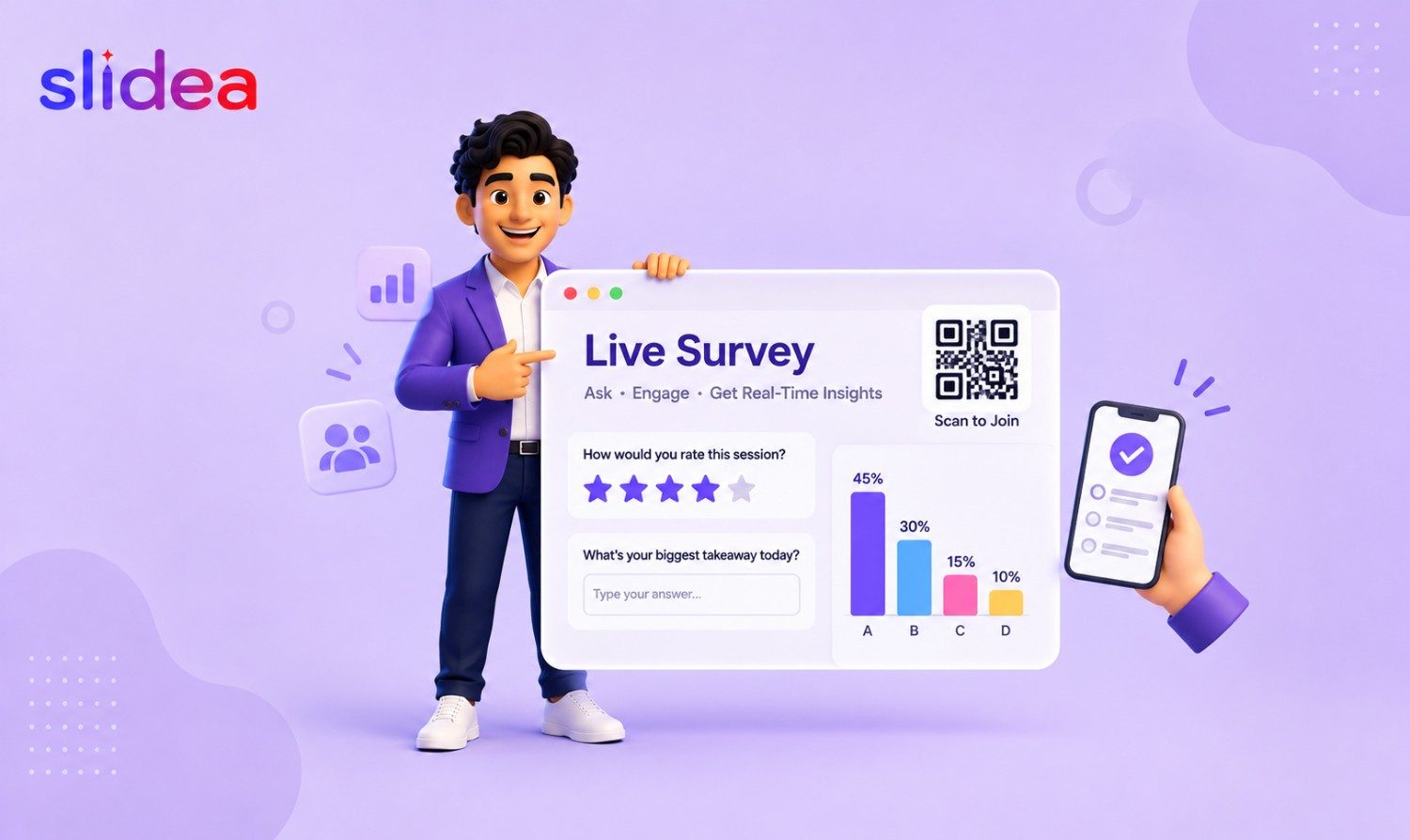
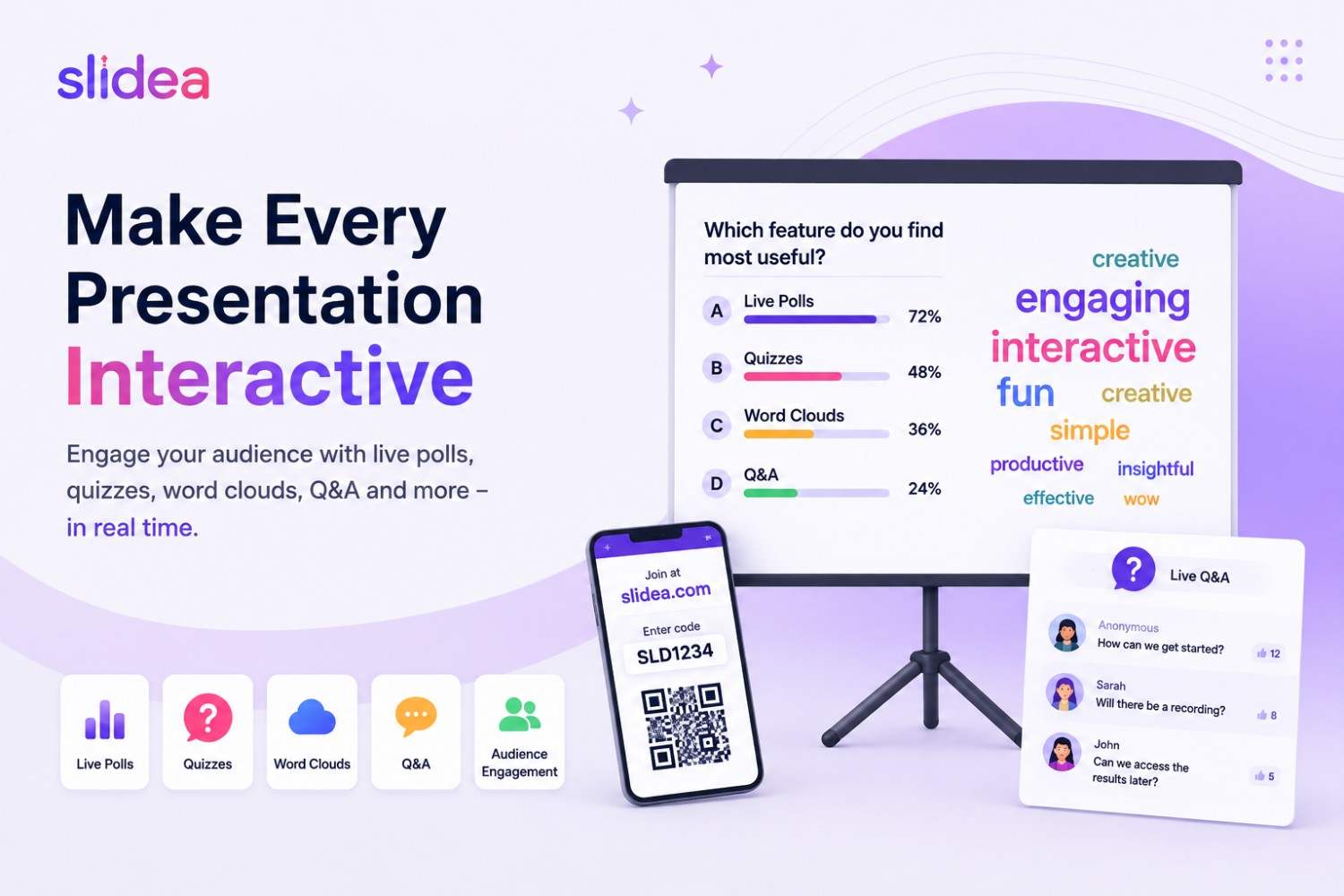
Slidea is an interactive presentation platform that lets you embed open-ended questions directly into your slides and collect live responses from your entire audience at the same time. No waiting for one person to raise their hand. No awkward silence while everyone waits for someone else to go first. Just instant, simultaneous responses from every single person in the room, on their own device, in their own words.
Here is how Slidea's features make open-ended questions more powerful in any setting:
Open-Ended Response Slide
Add your open-ended question to a slide and let the audience type their full answer from their phone or laptop. Every response appears live on the presentation screen as it comes in, one after another, so the whole room can read, react to, and build on each other's answers in real time. It is the most natural, pressure-free way to run a group discussion because no one has to speak out loud if they do not want to. Every voice still gets heard.
Word Cloud for One-Word Warm-Ups
Before going deep with a full open-ended question, you can use the word cloud feature to warm the room up. Ask something like "Give one word for how you are feeling about today's topic" and watch the answers appear instantly as a growing, colorful word cloud on screen.
Live Polls for Context Setting
Before asking a big open-ended question, you can run a quick live poll to give the group a shared starting point. For example, before asking "What do you think is the biggest challenge facing our team right now?", run a quick poll asking everyone to rate team communication from one to five. The results appear live on screen, they spark immediate conversation, and they give the open-ended discussion that follows a grounded, data-backed starting point.
Slidea works seamlessly for in-person sessions, fully virtual meetings, and hybrid events. Your audience joins by scanning a simple QR code or clicking a link or using a number code, no app download needed, no setup required. Just instant, real audience engagement from the moment your first open-ended question hits the screen.
Final Thoughts
One simple change in the way you ask questions can completely transform how people respond. Closed questions give you quick answers, but open-ended questions give you insight, emotion, and real understanding. They turn short replies into meaningful conversations that actually help you learn, connect, and solve problems.
When you bring open-ended questions into your classroom, meetings, or discussions, and support them with tools like Slidea, every voice gets a chance to be heard. Ideas flow more freely, participation increases, and conversations become more valuable. In the end, it’s not just about asking questions. It’s about asking the kind of questions that truly open people up.
FAQs
Q1. What is an open-ended question with an example?
An open-ended question is a question that cannot be answered with a simple yes or no. For example, “What do you think about this idea?” allows a detailed response.
Q2. What is the difference between open-ended and closed-ended questions?
Open-ended questions allow detailed answers and encourage discussion, while closed-ended questions have fixed answers like yes, no, or a specific fact.
Q3. Why are open-ended questions important?
Open-ended questions help improve communication, encourage critical thinking, and create deeper conversations in classrooms, meetings, and interviews.
Q4. When should you use open-ended questions?
Use open-ended questions when you want to understand opinions, gather feedback, or start meaningful discussions instead of getting quick answers.
Q5. How do you write a good open-ended question?
Start with words like what, how, or why. Keep the question simple and clear, and make sure it invites explanation instead of a one-word answer.

Your email address will not be published. Required fields are marked *