


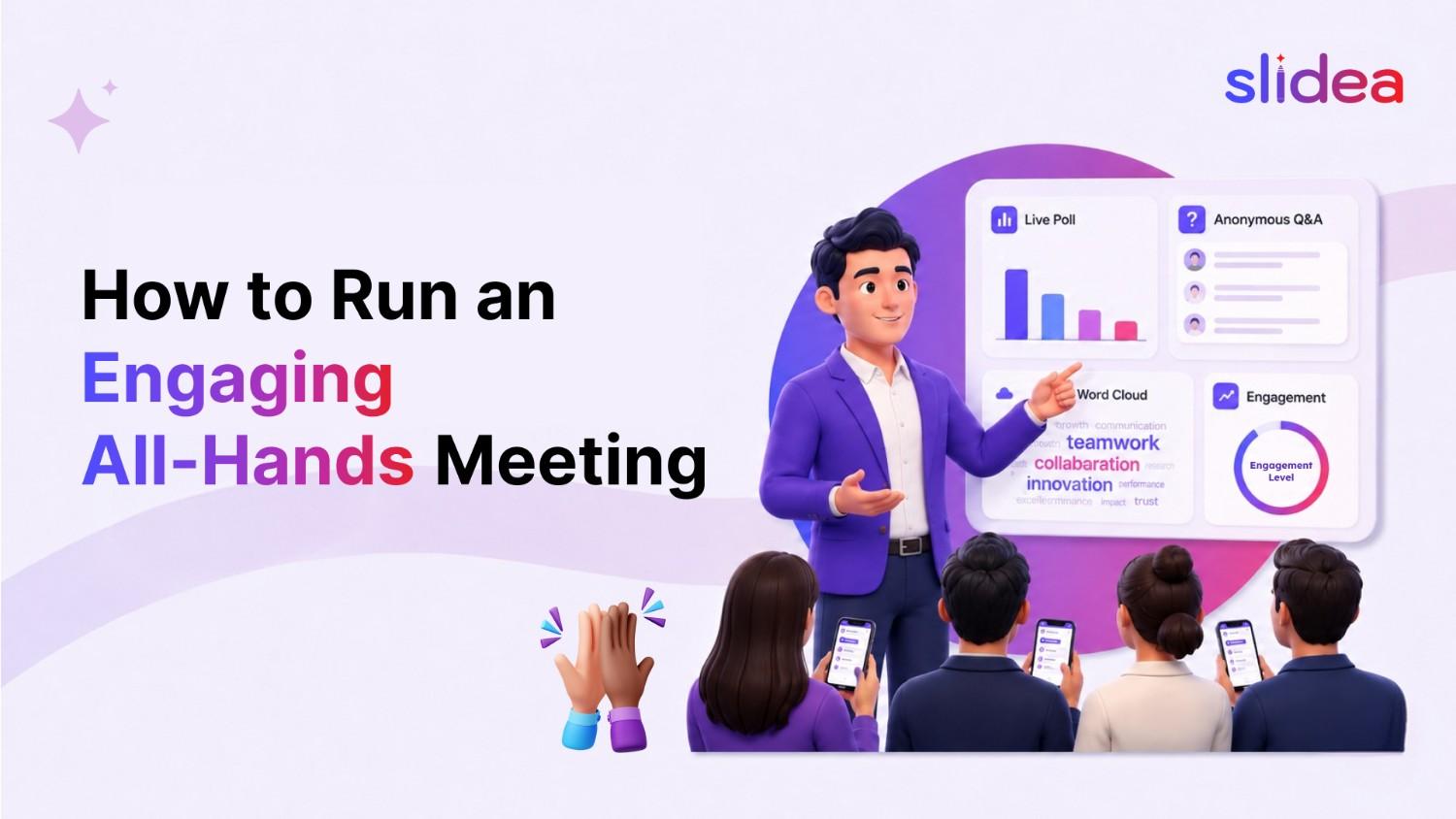
An engaging all-hands meeting combines a clear agenda, structured audience participation, and real-time feedback tools. The meetings that work best open with a live poll or word cloud, include anonymous Q&A throughout rather than just at the end, and close with a collective activity that gives every employee a voice. The ones that fail treat the all-hands as a broadcast, leadership talking, everyone else listening.
Here is an uncomfortable truth about all-hands meetings.
According to Gallup's 2026 State of the Global Workplace report, global employee engagement fell to 20% in 2025, its lowest level since 2020, costing the global economy an estimated $10 trillion in lost productivity. That means when you bring your entire company together for an all-hands meeting, roughly 4 in 5 employees in the room are not actively engaged at work.
An all-hands meeting is the single most powerful tool leadership has to change that. It is also the tool most likely to make things worse when it runs as a one-way broadcast.
The difference between an all-hands meeting that builds alignment and one that burns trust comes down to one thing: whether employees feel heard, or whether they feel like an audience.
For the research behind audience participation and engagement outcomes, see our interactive presentation statistics.
What Is an All-Hands Meeting?
An all-hands meeting, sometimes called a town hall, company-wide meeting, or all-staff meeting, is a gathering where every employee comes together to hear updates from leadership, align on company goals, and engage in two-way dialogue.
The name comes from the phrase all hands on deck, everyone, regardless of seniority, role, or department, is expected to attend. Unlike department meetings or team standups, the all-hands is the one moment where the entire organisation is in the same conversation at the same time.
Done well, it creates alignment, builds trust, and makes every employee feel connected to the direction the company is heading. Done poorly, it is 60 minutes of slides and corporate updates that nobody will remember by Monday morning.
Why Most All-Hands Meetings Fail
The most common format looks like this: leadership presents a deck of company updates, a few pre-selected questions get answered at the end, and everyone leaves. This format has three structural problems.
- It is a monologue. When only leadership speaks, employees are passive recipients of information rather than active participants in a conversation. Passive audiences disengage faster and retain significantly less than active participants.
- The Q&A is broken. End-of-meeting Q&A produces the same three questions from the same three confident people. Everyone else stays silent, not because they have no questions, but because asking in front of the whole company feels risky. Anonymous Q&A tools change this completely.
- There is no feedback loop. Leadership presents. Employees listen. Nobody knows what employees actually think, what they are worried about, or what they need more clarity on. The meeting ends without any real data on whether it worked.
What an Engaging All-Hands Meeting Looks Like
The companies whose all-hands meetings employees actually look forward to share a common structure. Leadership and employee voices alternate. Participation is built in at regular intervals. Every employee has a way to contribute without having to speak out loud in front of the whole company.
The structure that works consistently across organisations of every size follows this pattern.
Opening: 5 minutes
An interactive warm-up before the agenda begins. A live word cloud asking how employees are feeling, a pulse check on company sentiment, or a quick multiple choice question on a relevant topic. This signals immediately that the meeting is a two-way conversation and gives leadership real data on the room before a single slide is shown.
Company updates: 15 to 20 minutes
Leadership presents the key updates. Keep this section focused on what matters most, strategic direction, major milestones, and the honest state of the business. Include moments for employees to respond: a quick poll after a major announcement, a word cloud asking for one-word reactions to a new initiative.
Department or team spotlight: 10 minutes
Give different voices the floor. A project update from a team that normally would not present to the whole company. A customer story from sales or support. This reduces the executives-talking-at-employees dynamic and shows the breadth of what the organisation is doing.
Anonymous Q&A: 15 minutes
This is the most important section of the meeting. Run the live Q&A feed throughout the entire session, not just at the end, so employees can submit questions the moment they occur. Anonymous submission removes the fear of asking a difficult question in public. The questions that surface when anonymity is guaranteed are the questions employees have actually been thinking about.
Closing: 5 minutes
A collective activity that involves everyone simultaneously. A ranking poll on the company's priorities for next quarter. An open-ended question asking what employees most want to see more of. A word cloud capturing the energy of the room in one word. This gives every employee a voice at the close and gives leadership data to act on.
All-Hands Meeting Agenda Structure
| Section | Duration | Format |
| Opening warm-up | 5 minutes | Live word cloud or pulse poll |
| Company updates | 15 to 20 minutes | Slides with embedded polls |
| Department or team spotlight | 10 minutes | Live presentation |
| Anonymous Q&A | 15 minutes | Live Q&A feed open throughout |
| Closing activity | 5 minutes | Word cloud, ranking, or open-ended |
| Total | 50 to 55 minutes |
Keep the meeting under 60 minutes. Engagement drops significantly beyond this point. If your agenda consistently runs longer, the problem is scope rather than available time, prioritise ruthlessly rather than extending the session.
The Anonymous Q&A Problem, and How to Fix It
This deserves its own section because it is the single most impactful change most organisations can make to their all-hands meetings.
Standard end-of-meeting Q&A suffers from a fundamental design problem. Asking a question out loud in front of the entire company requires confidence, a belief that the question will be received well, and a willingness to be identified as the person who asked it. These are significant barriers. Most employees never ask the questions they actually want answered.
Anonymous Q&A removes all three barriers simultaneously. When employees can submit questions from their phone without their name attached, participation rates increase dramatically. The questions that emerge are more substantive, more honest, and more useful to leadership than the polished questions that surface in traditional Q&A.
The practical implementation is straightforward. Open the Q&A feed at the start of the meeting, not at the end. Let employees submit and upvote questions throughout the entire session. The highest-upvoted questions rise to the top automatically, so the most important questions get answered rather than the first ones submitted. Address the top questions directly, including the difficult ones. Employees notice when hard questions are answered honestly, and they notice when they are deflected.
Interactive Tools That Make All-Hands Meetings Work
The difference between a passive all-hands and an engaging one is not the content, it is the mechanism for participation. These are the interaction types that work best in an all-hands context.
- Opening word cloud. In one word, how are you feeling about the company's direction right now? A word cloud gives leadership an immediate, honest read on employee sentiment before the meeting begins. The visual result appearing on screen in real time tells the whole room something about how the whole room feels.
- Live pulse polls. After a major announcement or strategic update, a quick multiple choice poll gives employees a structured way to respond. How clear does our Q3 strategy feel after today's update? with response options from very clear to still confused gives leadership actionable feedback in seconds.
- Sentiment ranking. A ranking slide asking employees to order the company's priorities from most to least important surfaces the gap between what leadership thinks matters and what employees actually think matters. That gap, when it exists, is information leadership needs.
- Anonymous open-ended questions. Beyond Q&A, open-ended questions gather specific feedback: What is the one thing leadership could do to make your work easier? or What are you most uncertain about heading into next quarter? Collected anonymously and displayed in real time, these give leadership a window into what the organisation is actually thinking.
For a full guide on choosing which interaction type to use and when, see our interactive presentation ideas for meetings, classrooms, training and events.
Running an All-Hands Meeting for Remote and Hybrid Teams
The engagement challenge is more acute in remote and hybrid settings. When half the company is watching on a screen, the risk of passive viewing is significantly higher than in a room. Remote attendees can disappear without being noticed.
The same interactive tools that work for in-person all-hands meetings work for remote and hybrid ones, but they matter even more. A remote employee who submits a word cloud response, votes in a poll, or upvotes a Q&A question is an active participant. A remote employee who just watches is a viewer.
Practical adjustments for remote and hybrid all-hands meetings:
- Assign someone to monitor the Q&A feed and remote chat. Remote questions should be read aloud and given equal weight to in-room questions.
- Use the opening word cloud as a deliberate inclusion mechanism. When every attendee, in-room and remote, responds to the same question simultaneously, the meeting starts as a shared experience rather than a divided one.
- Keep camera expectations realistic. Mandatory cameras for a 300-person all-hands is counterproductive. Structured participation through polls and Q&A is a better engagement mechanism than camera enforcement.
- Run post-meeting analytics. Every interactive session generates data on which questions got the most responses, where participation dropped, and what employees felt was most important. This data is unavailable from a passive presentation.
All-Hands Meeting Ideas to Increase Participation
If your all-hands meetings are consistently producing low participation or low energy, these approaches have proven effective across different organisation sizes and formats.
- Open with a team recognition moment. Before the first slide, name a specific employee or team who did something worth celebrating. This sets an immediate tone of appreciation and signals that the meeting values people, not just updates.
- Rotate speakers. When the same executives present every all-hands, the meeting feels like a broadcast from on high. Inviting a different team to present a project update, a customer win, or a lesson learned from a failure brings fresh energy.
- Share real numbers. Employees disengage from all-hands meetings that feel like PR exercises. Sharing honest metrics, including the ones that are not great, builds more trust than presenting only the wins.
- Ask before the meeting. Collect questions, topics, and concerns from employees before the all-hands begins. A simple anonymous form sent 48 hours before the meeting surfaces issues leadership might not know are on people's minds.
- Use the data after the meeting. Post-session analytics from an interactive all-hands show which questions got the most upvotes, which polls got the highest response rates, and what employees said in open-ended questions. Acting on this data visibly closes the feedback loop that most all-hands meetings leave open.
How to Run an All-Hands Meeting With Slidea
Slidea's all-hands meeting solution is built specifically for this format, large audiences, mixed confidence levels, and the need for every employee to have a voice without having to speak out loud.
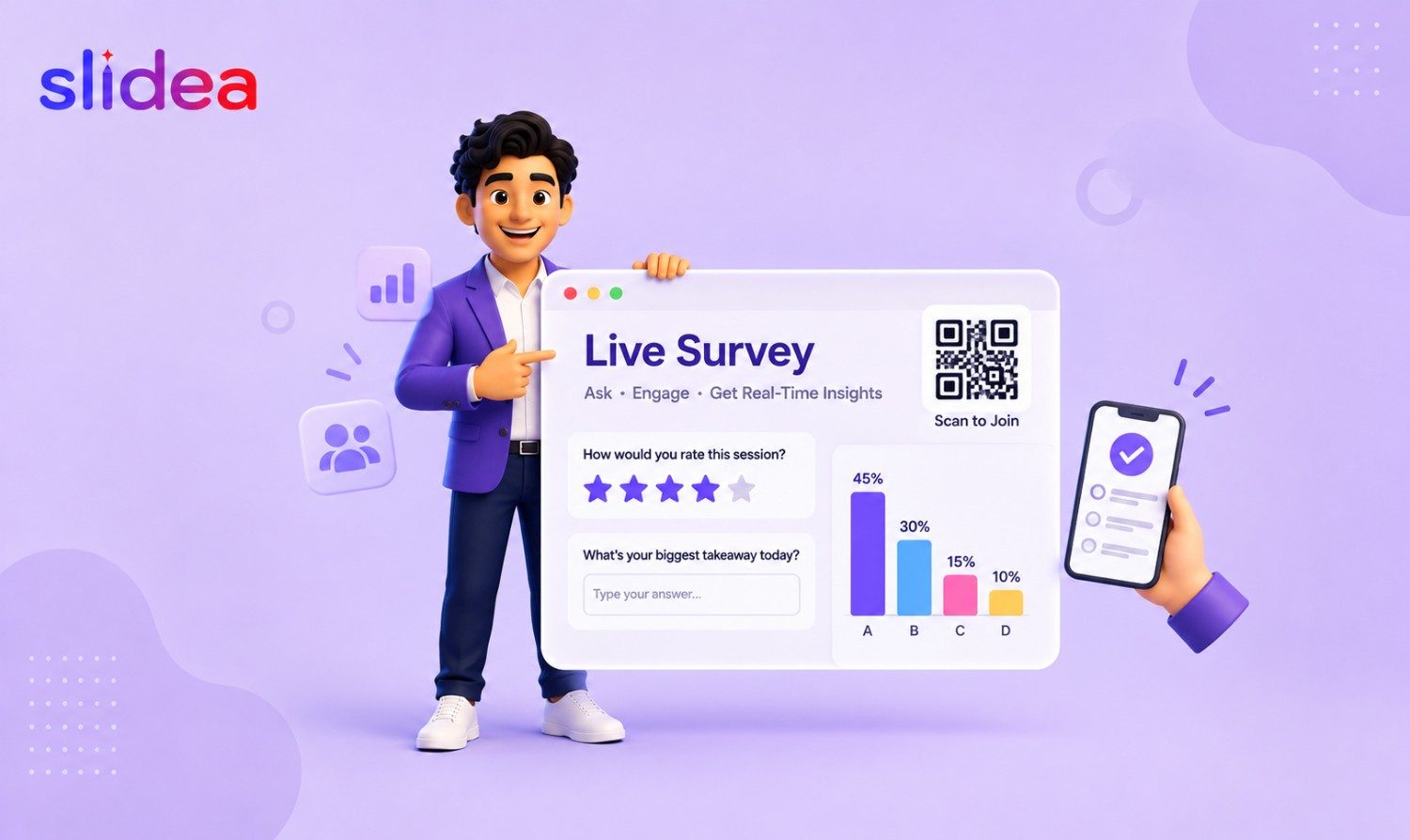
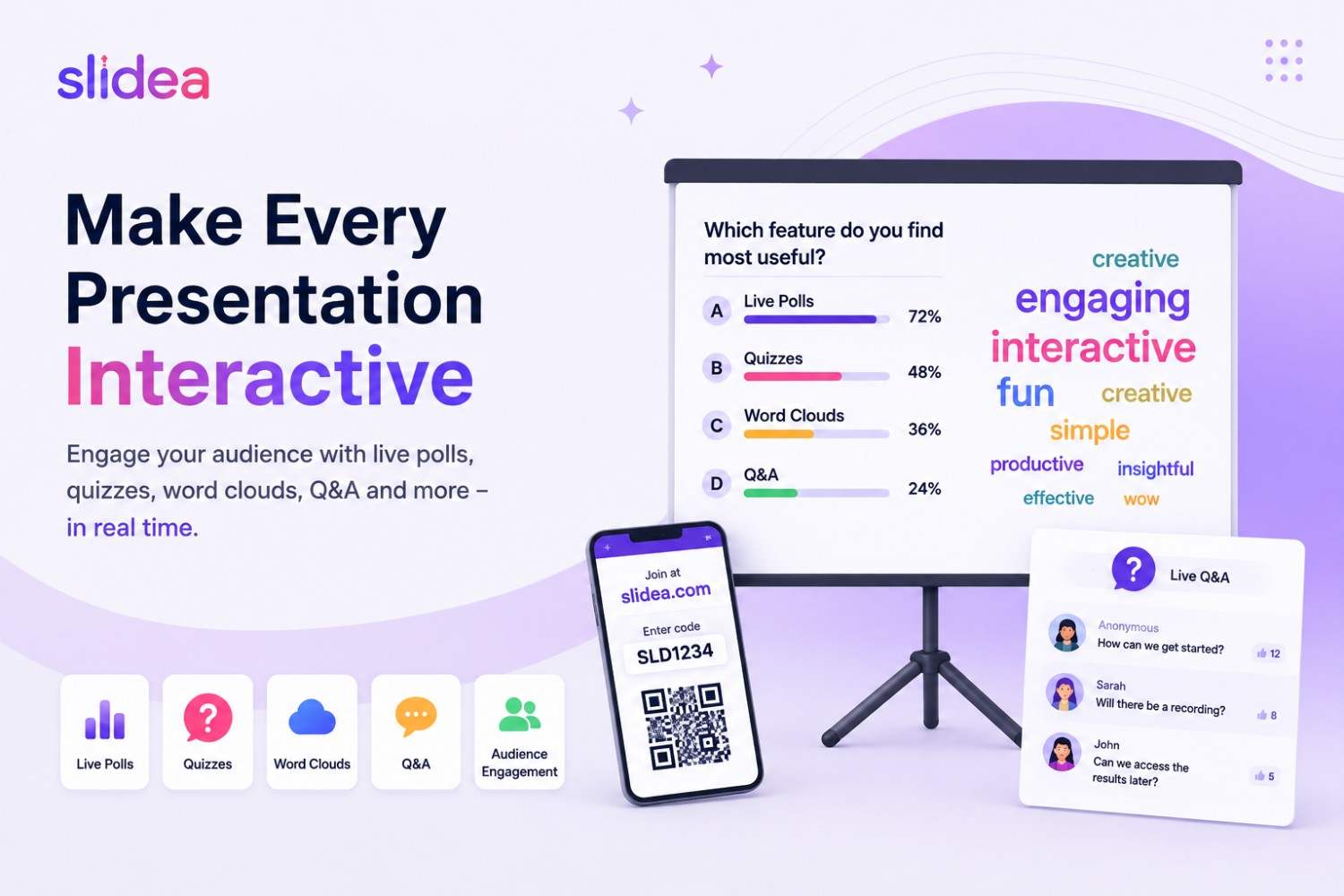
A typical Slidea all-hands session includes an opening word cloud or pulse poll, a live Q&A feed running throughout the full session with anonymous submission and upvoting, embedded polls within the main presentation slides, a ranking or open-ended activity at the close, and post-session analytics showing participation rates, top questions, and response distributions.
The audience joins by scanning a QR code on screen from their phone, no app download, no account creation, no technical friction. Whether the meeting is in-person, remote, or hybrid, every employee participates the same way.
See our town hall meeting templates for ready-made all-hands structures you can customise and present in minutes.
Common All-Hands Meeting Mistakes to Avoid
- Running it as a broadcast. If the only participation mechanism is raising a hand to ask a question at the end, you have a broadcast, not a meeting. Build participation into the structure from the first minute.
- Skipping difficult questions. Employees remember when leadership deflects a hard question. The trust damage from deflection lasts longer than the discomfort of answering honestly.
- Running too long. A 90-minute all-hands is not a more valuable all-hands. It is a meeting that lost the room 30 minutes ago. Keep it under 60 minutes.
- No follow-up. The all-hands meeting is not the end of the conversation, it is the beginning of one. Share a summary of key points, post the Q&A responses that could not be answered live, and communicate what actions leadership is taking based on employee input.
- Same format every time. If your all-hands follows exactly the same structure every quarter, attendance and engagement will drift. Introduce a new element each time, a different opening activity, a panel format, a team spotlight from a department that has not presented before.
Frequently Asked Questions
How often should you run an all-hands meeting?
Most organisations run all-hands meetings monthly or quarterly. Monthly cadences work well for fast-moving teams where alignment needs to be maintained regularly. Quarterly works better for larger organisations where logistics are more complex. The cadence matters less than the consistency, pick a frequency and maintain it.
How long should an all-hands meeting be?
60 minutes is the widely recommended maximum. Long enough to cover the essential content, short enough to hold attention throughout. If you consistently need more than 60 minutes, the problem is usually agenda scope rather than available time.
What should be on an all-hands meeting agenda?
The most effective all-hands agendas include a company update on strategic direction and key metrics, one or two department or team spotlights, an anonymous Q&A section, and a closing activity that involves the whole company. Avoid packing in too many updates, prioritise what employees most need to hear over what leadership most wants to say.
How do you handle difficult questions in an all-hands meeting?
Answer them honestly, even when the honest answer is incomplete. I cannot share the specifics of that decision yet but I will update everyone by the end of the month is significantly better than deflection. Employees who see difficult questions answered directly trust leadership more, not less.
What is the difference between an all-hands meeting and a town hall?
In most organisations the terms are used interchangeably. If a technical distinction applies: an all-hands typically emphasises alignment and updates for the whole company, while a town hall places greater emphasis on Q&A and two-way dialogue between leadership and employees. In practice, the best versions of both look the same, structured participation, anonymous Q&A, and a clear agenda.
What tools work best for all-hands meetings?
Interactive presentation tools that support live polling, anonymous Q&A, and word clouds make the biggest difference to all-hands engagement. The audience should be able to participate from their phone without downloading anything. For large organisations, anonymous submission is essential, it removes the social risk of asking a question in front of the whole company. See our all-hands meetings solution page for how Slidea supports this format specifically.
The All-Hands Meeting Is a Leadership Tool, Not a Calendar Event
The gap between an all-hands meeting that builds alignment and one that accelerates disengagement comes down to a single design decision: is this a conversation or a broadcast?
With global employee engagement at its lowest level in five years, the all-hands meeting has never mattered more. Every employee in that room, on screen or in person, is making a judgment about whether leadership values their voice or just their attendance.
The tools and structure to make every all-hands genuinely interactive already exist. The question is whether leadership is willing to hear what employees actually have to say.



Leave a Comment
Your email address will not be published. Required fields are marked *