



What if the best exam you ever took was also the funniest one? Not the kind of exam that makes your palms sweat and your brain go blank, but the kind that makes you snort-laugh at question three and then genuinely have to think hard about question four because the answer is not what it seems.
Silly exam questions are one of the most underrated tools in any teacher's, trainer's, or event host's toolkit. They look easy and sound ridiculous. And then they catch you completely off guard with an answer that is technically, perfectly, undeniably correct, and yet nothing like what you expected.
The beauty of a silly exam is that it does three things at once. It makes people laugh. It makes people think. And it makes people pay attention, because once someone gets caught out by a trick question, they start reading every question twice and thinking twice before answering. That level of engagement is something even the most carefully designed serious exam struggles to achieve.
Silly exam questions work brilliantly in classrooms, team training sessions, quiz nights, school events, virtual meetings, and hybrid events. They work for all ages, from primary school students who love the silliness to corporate teams who need a reason to loosen up before a serious session.
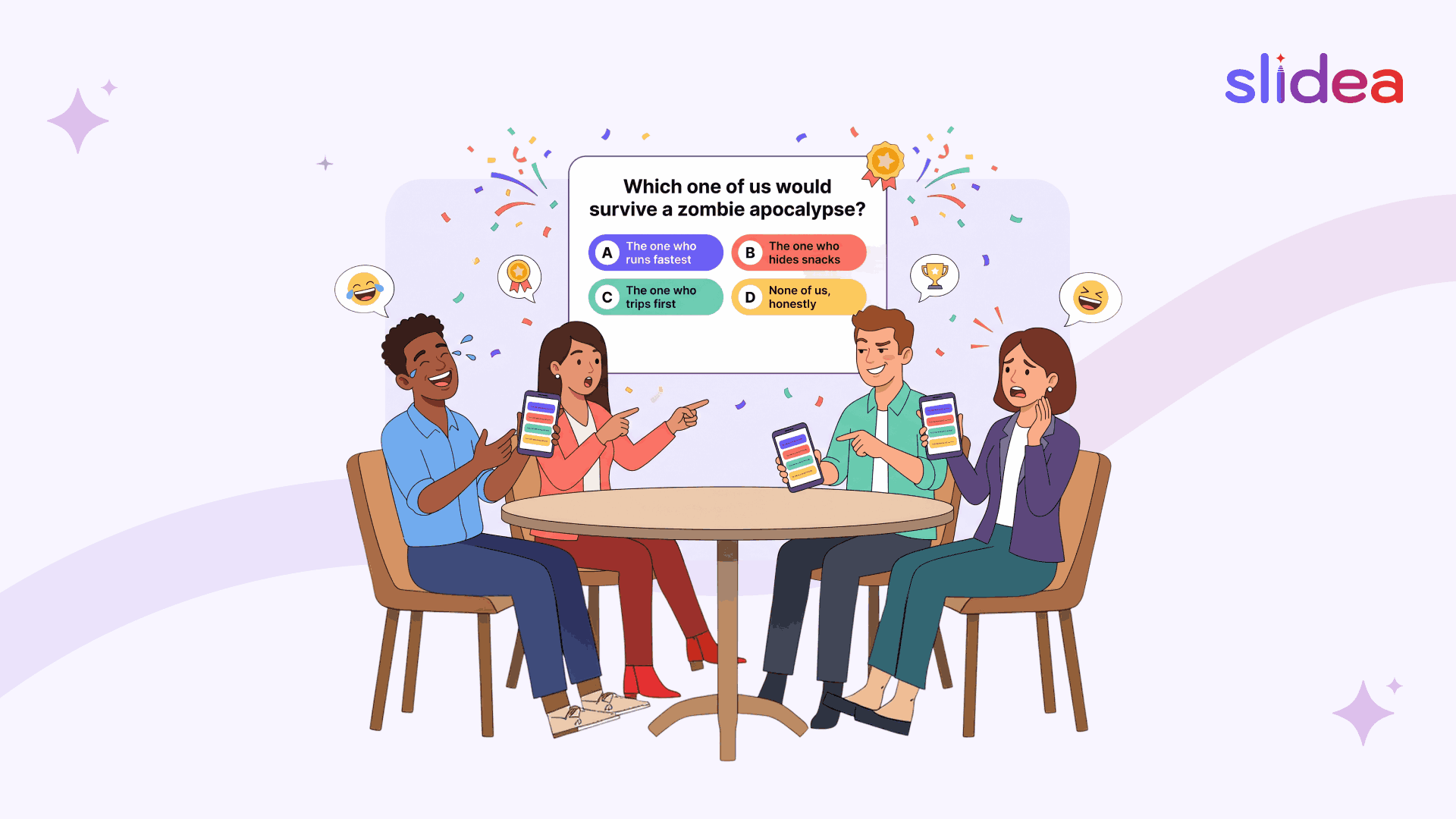
And when you run them on a smart interactive quiz maker, the moment someone picks the obvious wrong answer and sees that 80% of the room made the same mistake, the laughter is instant, genuine, and the kind that brings a whole group together.
In this blog, you will find 100+ silly, funny, and tricky exam questions with answers sorted across fun categories, all ready to use in your next classroom session, quiz night, or team event.
What Makes a Silly Exam Question So Effective?
The best silly exam questions are not random nonsense. They are carefully constructed questions that use clear, simple language to lead the reader confidently toward the wrong answer. The reader thinks they know what is being asked. They answer quickly. And then the actual answer, which was sitting right there in the question the whole time, makes them laugh at themselves.
This works because of a concept called cognitive bias. Our brains naturally look for patterns and take shortcuts when processing information. A silly exam question playfully uses those shortcuts to surprise people in the most entertaining way possible.
That surprise is also what makes these questions so powerful for live engagement. The moment people realize they misunderstood a simple question, the reactions are immediate. People laugh, debate the answer, and suddenly become far more focused on every question that follows. One tricky question instantly pulls the whole group into the experience together.
Beyond the laughs, silly exam questions also serve a real educational purpose. They train people to read carefully, think critically, and avoid answering on autopilot. Those are genuinely useful skills, wrapped inside something that feels light, fun, and highly interactive.
Category 1: Classic Tricky Questions
These are the timeless silly exam questions that catch almost everyone the first time.
- If a red house is made of red bricks and a blue house is made of blue bricks, what is a greenhouse made of?
Answer: Glass, a greenhouse is always made of glass.
- A farmer has 17 sheep. All but 9 ran away. How many sheep does the farmer have left?
Answer: 9, "all but 9" means 9 remain.
- How many months have 28 days?
Answer: All 12 months, every month has at least 28 days.
- A rooster sits on the peak of a roof. It lays an egg. Which side does the egg roll down?
Answer: Neither, roosters do not lay eggs.
- You are in a race and you overtake the person in second place. What position are you in now?
Answer: Second place, you did not overtake the person in first.
- If there are 3 apples and you take away 2, how many apples do you have?
Answer: 2, you took 2, so you have 2.
- A doctor gives you 3 pills and tells you to take one every half hour. How long before all the pills are gone?
Answer: One hour, pill 1 at 0 minutes, pill 2 at 30 minutes, pill 3 at 60 minutes.
- How far can a dog run into the woods?
Answer: Halfway, after that it is running out of the woods.
- What do you call a woman who knows where her husband is every night?
Answer: A widow.
- What has a head and a tail but no body?
Answer: A coin.
- You have a match. You enter a dark room with a candle, an oil lamp, and a fireplace. What do you light first?
Answer: The match.
- Which is heavier, a ton of feathers or a ton of bricks?
Answer: Neither, they both weigh exactly one ton.
- If an electric train is traveling north, which way does the smoke blow?
Answer: There is no smoke, it is an electric train.
- A man builds a house with four sides. Every side has a southern view. A bear walks by. What color is the bear?
Answer: White, the only place this is possible is the North Pole, where polar bears live.
- What can you catch but never throw?
Answer: A cold.
- How many seconds are in a year?
Answer: 12, January 2nd, February 2nd, March 2nd, and so on.
- What two things can you never eat for breakfast?
Answer: Lunch and dinner.
- If you threw a white stone into the Red Sea, what would it become?
Answer: Wet.
- A man rode into town on Friday, stayed two nights, and left on Friday. How?
Answer: His horse's name was Friday.
- What gets wetter the more it dries?
Answer: A towel.
Category 2: Math and Number Tricks
These questions use numbers to fool the brain into making quick, wrong calculations.
- If you multiply all the numbers on a phone keypad together, what do you get?
Answer: Zero, there is a zero on the keypad, and anything multiplied by zero is zero.
- A bat and ball cost one dollar and ten cents. The bat costs one dollar more than the ball. How much does the ball cost?
Answer: Five cents, not ten cents. The bat costs one dollar and five cents, and the ball costs five cents.
- How many times can you subtract 10 from 100?
Answer: Once, after that you are subtracting from 90, then 80, and so on.
- Two fathers and two sons went fishing. They caught three fish in total and each person got one fish. How is that possible?
Answer: There were only three people, a grandfather, a father, and a son. The father is both a father and a son.
- If you have a bowl with six apples and you take away four, how many apples do you have?
Answer: Four, the ones you took.
- What number when multiplied by itself gives the same result as adding it to itself?
Answer: 2, two times two equals four, and two plus two also equals four.
- What is the next number in the sequence, 1, 2, 4, 8, 16?
Answer: 32, each number doubles.
- If five cats catch five mice in five minutes, how long does it take one cat to catch one mouse?
Answer: Five minutes, the rate is one cat catches one mouse in five minutes.
- How many times does the digit 1 appear between 1 and 100?
Answer: 21 times, 1, 10, 11, 12, 13, 14, 15, 16, 17, 18, 19, 21, 31, 41, 51, 61, 71, 81, 91, and 100.
- If a plane crashes on the border of the United States and Canada, where do they bury the survivors?
Answer: You do not bury survivors, they are alive.
- What is 1 plus 1?
Answer: 2, but read the question again. This is the only question on this list with an obvious answer. Did you second-guess yourself anyway?
- A snail is at the bottom of a 10-meter well. Every day it climbs 3 meters and slides back 2 meters at night. How many days does it take to reach the top?
Answer: 8 days, on day 8 it reaches 10 meters during the day and exits without sliding back.
- If you divide 30 by half and add 10, what do you get?
Answer: 70, dividing by half means multiplying by 2, so 30 multiplied by 2 is 60, plus 10 is 70.
- There are 12 birds on a fence. A farmer shoots one. How many are left?
Answer: Zero, the rest fly away when they hear the shot.
- If you have two coins totaling 30 cents and one of them is not a nickel, what are the two coins?
Answer: A quarter and a nickel, one of them is not a nickel, but the other one is.
Category 3: Word Play and Language Tricks
These questions play with the meaning of words to catch readers off guard.
- What word is spelled incorrectly in every dictionary?
Answer: The word "incorrectly."
- What has keys but no locks, space but no room, and you can enter but cannot go inside?
Answer: A keyboard.
- The more you take the more you leave behind. What is it?
Answer: Footsteps.
- What word becomes shorter when you add two letters to it?
Answer: Short, add "er" and it becomes "shorter."
- A man shaves several times a day but still has a beard. How?
Answer: He is a barber, he shaves his customers, not himself.
- What is always in front of you but cannot be seen?
Answer: The future.
- What can run but never walks, has a mouth but never talks, has a head but never weeps, has a bed but never sleeps?
Answer: A river.
- What has one eye but cannot see?
Answer: A needle.
- What is full of holes but can still hold water?
Answer: A sponge.
- What goes up but never comes down?
Answer: Your age.
- What has hands but cannot clap?
Answer: A clock.
- What starts with the letter E, ends with the letter E, and contains only one letter?
Answer: An envelope.
- What is always coming but never arrives?
Answer: Tomorrow.
- What can you break without touching it, dropping it, or hitting it?
Answer: A promise.
- What has cities but no houses, mountains but no trees, and water but no fish?
Answer: A map.
More Word Games and Language Challenges:
- Fans of clever riddles and vocabulary puzzles will also enjoy the free online crossword puzzle games for extra brain-teasing fun.
- Want to improve your word strategy skills? Explore the best words to win at Wordle and level up your guessing game.
Category 4: Science and Nature Silliness
These questions use real science facts to create genuinely surprising answers.
- What is the hottest planet in our solar system?
Answer: Venus, not Mercury, even though Mercury is closer to the sun. Venus has a thick atmosphere that traps heat.
- How long does it take for sunlight to reach Earth?
Answer: About 8 minutes and 20 seconds.
- What do you call a fish without eyes?
Answer: A fsh, remove the letter "i" from fish.
- What planet has the most moons?
Answer: Saturn, with 146 confirmed moons as of recent discoveries.
- What is heavier, cold air or warm air?
Answer: Cold air, it is denser and therefore heavier than warm air.
- A cat has 3 kittens named January, March, and May. What is the mother's name?
Answer: What, "What is the mother's name" is the question, and the name is whatever you read first. Reread the question.
- How much dirt is in a hole that is 3 feet wide and 3 feet deep?
Answer: None, a hole has no dirt in it.
- What do you call a sleeping dinosaur?
Answer: A dino-snore.
- If you drop a feather and a bowling ball from the same height in a vacuum, which hits the ground first?
Answer: Neither, they hit at exactly the same time. Without air resistance, gravity acts equally on both.
- What has a neck but no head?
Answer: A bottle.
- What kind of room has no doors or windows?
Answer: A mushroom.
- What runs around a yard without moving?
Answer: A fence.
- What goes through towns and over hills but never moves?
Answer: A road.
- How many animals did Moses take on the ark?
Answer: None, it was Noah, not Moses.
- What falls in winter but never gets hurt?
Answer: Snow.
Explore More Science and Nature Trivia:
- Want even more surprising facts and brainy challenges? Dive into these fun science quiz questions with answers for extra quiz inspiration.
- If your audience enjoys planet, climate, and environment-themed trivia, these engaging Earth Day quiz questions and answers are perfect for interactive learning sessions.
- Looking for more nature and sustainability trivia? Try these thought-provoking Earth Hour quiz questions to keep the fun going.
Category 5: Trick Questions About Everyday Life
These questions catch people out by using familiar situations in unexpected ways.
- You have a match. You walk into a room with a wood stove, a gas lamp, a candle, and a fireplace. What do you light first?
Answer: The match.
- A man is looking at a photograph. Someone asks who it is. The man says "Brothers and sisters I have none, but that man's father is my father's son." Who is in the photo?
Answer: His son.
- How long did the Hundred Years War last?
Answer: 116 years, from 1337 to 1453.
- What color is a school bus?
Answer: Yellow, did you automatically say "yellow" without thinking? Good, that one was actually straightforward.
- If you are running in a race and you pass the person in last place, what place are you in?
Answer: You cannot pass someone in last place, if you pass them, they become last and you move to their previous position.
- Which side of a dog has the most hair?
Answer: The outside.
- What do you put in a toaster?
Answer: Bread, if you said toast, you need to re-read the question.
- What is the name of the 4th month of the year?
Answer: April.
- A rooster lays an egg at the top of a roof. Which way does it roll?
Answer: Roosters do not lay eggs, hens do.
- If there are 10 birds on a wire and you shoot one, how many remain?
Answer: None, the rest fly away at the sound of the shot.
- How many birthdays does the average person have?
Answer: One, you are only born once. You have birthday celebrations, but only one actual birthday.
- Some months have 30 days. Some have 31. How many months have 28 days?
Answer: All 12.
- What was the highest mountain in the world before Mount Everest was discovered?
Answer: Mount Everest, it was still the highest mountain. It just had not been discovered yet.
- Is it legal for a man to marry his widow's sister?
Answer: No, if he has a widow, he is dead.
- A cowboy rides into town on Friday and leaves two days later on Friday. How?
Answer: His horse's name is Friday.
Category 6: Funny One-Liners and Random Silliness
These are pure fun, silly, lighthearted questions that make people smile before they even read the answer.
- What do you call cheese that is not yours?
Answer: Nacho cheese.
- Why do scientists look forward to Fridays?
Answer: Because after W, X, Y, Z, the week is over.
- What do you call a bear with no teeth?
Answer: A gummy bear.
- What do elves learn in school?
Answer: The elf-abet.
- Why can you not give Elsa a balloon?
Answer: Because she will let it go.
- What did the ocean say to the beach?
Answer: Nothing, it just waved.
- What do you call a fake noodle?
Answer: An imposter.
- Why did the math book look so sad?
Answer: Because it had too many problems.
- What do you call a sleeping T-Rex?
Answer: A dinosaur.
- What do you call a fish wearing a crown?
Answer: A king fish.
- Why did the student eat his homework?
Answer: Because the teacher told him it was a piece of cake.
- What do you call a pig that does karate?
Answer: A pork chop.
- What do you call a dog magician?
Answer: A labra-cadabra-dor.
- Why did the bicycle fall over?
Answer: Because it was two-tired.
- What do you call a snowman with a six-pack?
Answer: An abdominal snowman.
- What do you call a factory that makes okay products?
Answer: A satisfactory.
- Why did the golfer bring an extra pair of pants?
Answer: In case he got a hole in one.
- What do you call a crocodile that is a detective?
Answer: An investi-gator.
- What do you call a noodle that is fake?
Answer: An impasta, yes, this one appeared twice. Did you notice?
- Why did the calendar go to therapy?
Answer: Because its days were numbered.
How Slidea Makes Silly Exam Questions Even More Fun
A silly exam is already entertaining on paper. But the moment you turn it into a live interactive experience where everyone answers together, the energy changes completely. People laugh louder, react faster, and stay engaged from the first question to the last.
Slidea helps turn simple trick questions into a full group activity that works beautifully in classrooms, training sessions, quiz nights, virtual meetings, and hybrid events.
| Slidea Quiz Feature | How It Works in Silly Exam Questions | Why It Makes the Quiz More Fun |
| Select Answer | Perfect for multiple-choice trick questions where participants choose from four possible answers directly from their phone or laptop. | Watching the live results appear on screen is hilarious when most of the room confidently picks the wrong answer. |
| Type Answer | Great for open-ended silly questions where participants must type the exact answer without hints or options. | Makes players think more carefully instead of guessing from choices, which creates fun surprise moments during answer reveals. |
| Pick the Number | Best for number-based trick questions like counting, timing, or math puzzles. Participants slide to choose a number on a scale. | Creates suspense and curiosity as everyone waits to see how close the group got to the correct answer. |
| Lineup | Participants drag and arrange answers into the correct order directly from their device. | Adds teamwork, discussion, and playful debate because almost nobody gets the exact order right the first time. |
With live participation, countdown timers, leaderboards, and instant reactions, Slidea transforms funny exam questions into a shared experience that keeps everyone involved and laughing together.
Final Thoughts
Silly exam questions prove something important, learning and laughter work incredibly well together.
A great trick question makes people pause, think carefully, laugh at themselves, and instantly want another question. That combination of curiosity and fun creates the kind of engagement that traditional quizzes often struggle to achieve.
The best part is that silly exam questions work almost anywhere. Teachers use them to make lessons more exciting. Trainers use them to wake up a room. Event hosts use them to break the ice. Friends use them to challenge each other just for fun.
And when you run them through interactive quiz platforms like Slidea, every question becomes a live group experience instead of just words on a page. Everyone answers together. Everyone reacts together. And those shared moments are what make people remember the activity long after it ends.
FAQs
Q1. What are silly exam questions?
Silly exam questions are funny or tricky questions designed to test careful thinking rather than serious academic knowledge. They often use wordplay, logic tricks, or misleading wording to surprise people.
Q2. Why are silly exam questions good for classrooms?
They make students more engaged, encourage critical thinking, improve reading attention, and create a fun learning environment that reduces stress and boredom.
Q3. How do you make a funny quiz more interactive?
Using an interactive quiz platform like Slidea allows participants to answer live from their devices, view instant results, compete on leaderboards, and react together in real time.
Q4. Are silly exam questions good for adults too?
Yes. Silly and tricky questions work well for adults in team meetings, training sessions, office events, virtual meetings, and quiz nights because they create laughter and encourage participation.
Q5. What is the difference between a pop quiz and a silly exam quiz?
A pop quiz usually focuses on knowledge across topics like history, science, or movies. A silly exam quiz focuses more on trick wording, funny logic, and unexpected answers designed to surprise participants.




Your email address will not be published. Required fields are marked *