


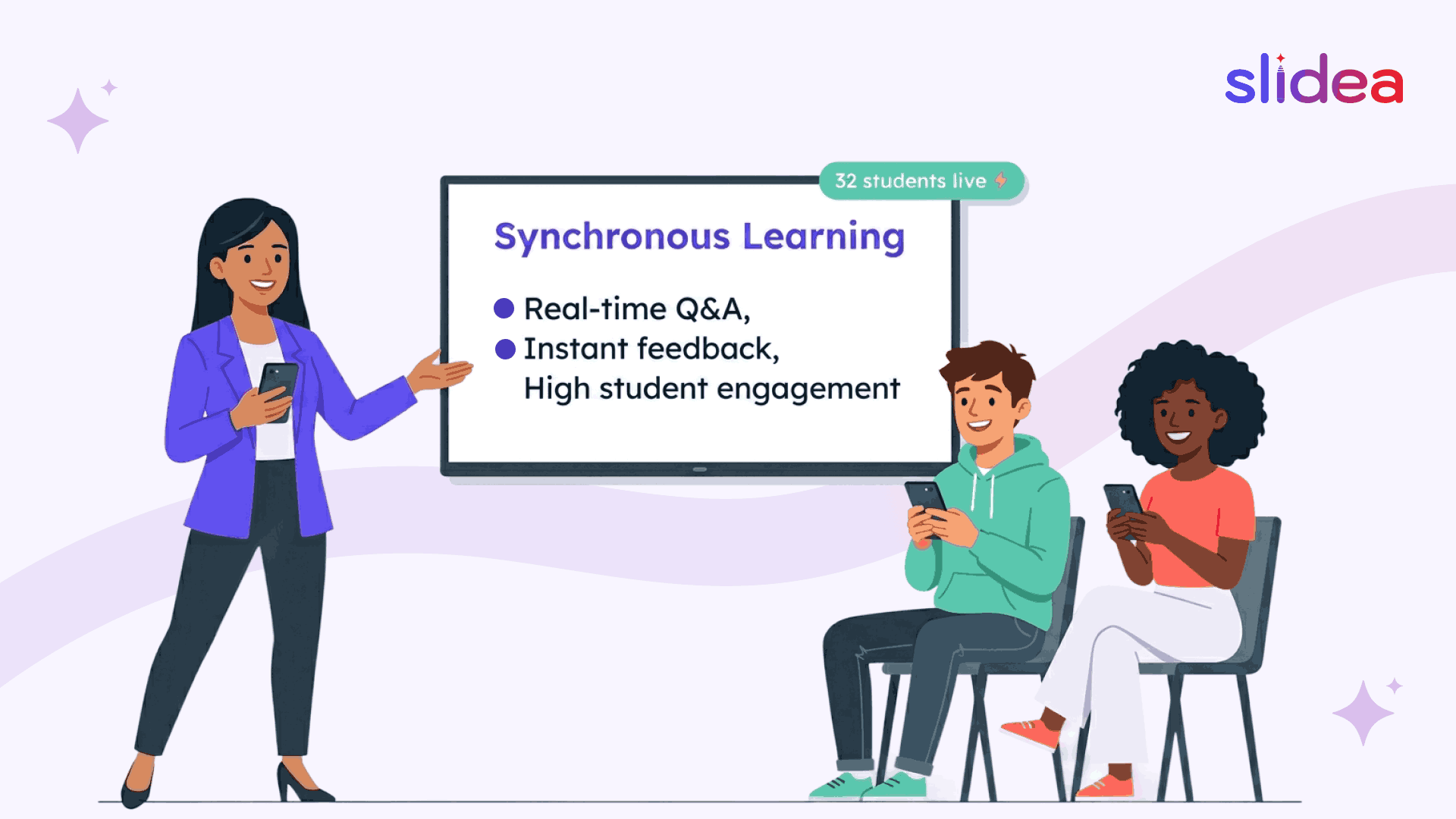
Think about the last time you learned something in a room, or on a call, with other people, all at the same moment. A teacher explained something and you asked a question right away. A trainer shared a concept and you discussed it with your group immediately. A presenter made a point and the whole room reacted together. That real-time, shared learning experience has a name, and it is called synchronous learning.
Synchronous learning is one of the oldest forms of education in the world. It is what happened in every classroom, every lecture hall, and every training room for centuries. But in today's world, where learning happens across time zones, remote setups, hybrid classrooms, and digital platforms, the definition of synchronous learning has grown far beyond the traditional classroom model.
Understanding what synchronous learning is, how it works, what makes it powerful, and where it falls short is genuinely useful for anyone involved in education, corporate training, professional development, or team learning. And knowing how to make synchronous learning more engaging, using smart interactive learning tools, is what separates a learning session people remember from one they forget the moment it ends.
In this blog, you will get a clear, simple explanation of synchronous learning, real examples across different settings, an honest look at its benefits, and a full walkthrough of how Slidea makes every synchronous learning session more interactive, more inclusive, and more effective.
What Is Synchronous Learning?
Synchronous learning is any type of learning that happens in real time, where the teacher or trainer and the learners are all present at the same time and interacting with each other live.
The word "synchronous" comes from the Greek words "syn" meaning together and "chronos" meaning time. So synchronous literally means happening at the same time.
In synchronous learning, everyone is in the same moment together. Questions are asked and answered immediately. Discussions happen live. Feedback is instant. And the learning experience is shaped by the real-time interaction between the students in the room, or on the call.
This is different from asynchronous learning, where learners access content at their own pace and in their own time, without a live instructor or real-time interaction. A pre-recorded video lesson, a self-paced online course, or a reading assignment are all examples of asynchronous learning. Synchronous learning is the live version, where everyone shows up at the same time and learns together.
Synchronous vs Asynchronous Learning
Understanding the difference between these two learning styles helps you choose the right approach for the right situation. Here is a simple comparison that makes both concepts crystal clear:
| Feature | Synchronous Learning | Asynchronous Learning |
| Timing | Happens in real time, with everyone participating at the same moment | Happens at each learner’s own pace and schedule |
| Interaction | Live interaction with instant questions, discussions, and feedback | Delayed interaction where responses and feedback come later |
| Examples | Live classes, video calls, webinars, workshops, virtual classrooms | Pre-recorded lessons, online courses, discussion boards, recorded tutorials |
| Flexibility | Less flexible because participants must join at a scheduled time | More flexible since learners can access content whenever convenient |
| Best For | Real-time collaboration, active discussion, group activities, and immediate clarification | Self-paced learning, revision, independent study, and flexible learning schedules |
Most modern learning programs use a blend of both, synchronous sessions for live interaction and discussion, and asynchronous content for independent study and review. Together they create what is often called blended learning.
Real Examples of Synchronous Learning
Synchronous learning shows up in more places than most people realize. Here are real examples across different settings that show how widely this approach is used today.
In Schools and Classrooms
The most familiar form of synchronous learning is the traditional classroom. A teacher stands in front of students, delivers a lesson, asks questions, and responds to student input in real time. Every student is present at the same time, experiencing the same lesson together. Virtual classrooms work the same way, the teacher is live on screen, students join from their devices, and the learning happens simultaneously for everyone in the session.
In Corporate Training and Professional Development
When a company runs a live training session, in person or on a video call, that is synchronous learning in action. The trainer presents content, facilitates discussions, runs activities, and answers questions in real time. New employee onboarding sessions, compliance training, product knowledge workshops, and leadership development programs are all common examples of synchronous learning happening every day in workplaces around the world.
In Webinars and Online Live Sessions
A webinar is a classic digital example of synchronous learning. Participants join a live session at a scheduled time, watch a presenter share information, ask questions through a chat or Q&A feature, and participate in live polls or discussions. The learning is happening in real time for every person on the call at the same moment, which is exactly what makes it synchronous.
In Virtual Meetings and Hybrid Events
Virtual team meetings where learning or upskilling is part of the agenda are a form of synchronous learning. Hybrid events, where some participants are in a physical room and others join remotely, are also synchronous when everyone is participating live at the same time. The challenge with hybrid synchronous learning is making sure the remote and in-person experience feel equally engaging and equally participatory for every person involved.
In Workshops and Group Training Sessions
Any workshop where participants gather, physically or virtually, to learn, practice, and discuss something together is synchronous learning. The live interaction between participants is what defines it. The group energy, the real-time debate, and the immediate application of ideas are the things that synchronous workshops create that a self-paced online course simply cannot replicate.
Benefits of Synchronous Learning
The reasons why synchronous learning remains one of the most widely used formats in education and training are grounded in real, proven advantages that benefit both learners and instructors.
Immediate Feedback and Clarification
In synchronous learning, confusion gets addressed the moment it happens. A student who does not understand something can ask right away and get an immediate answer. A trainer who notices blank expressions can pause and explain differently on the spot. That immediate feedback loop is one of the most powerful advantages of learning in real time, it prevents misunderstandings from compounding and keeps every learner genuinely on track throughout the session.
Real Human Connection
Learning alongside other people, even on a screen creates a sense of shared experience that self-paced learning simply cannot replicate. When a class debates a question together, or laughs together at something, or works through a problem together in real time, those shared moments build connection and make the learning feel meaningful rather than transactional. Human connection is one of the most consistent predictors of learning retention, and synchronous learning provides it naturally as part of the format itself.
Higher Accountability
When learners know they need to show up at a specific time, and that others will be there too, they are significantly more likely to attend, prepare, and engage than when they are left to work through content on their own schedule. The social accountability of synchronous learning is a genuine motivational force that keeps completion rates and engagement levels consistently higher than fully asynchronous alternatives over time.
Live Discussion and Collaboration
Some of the best learning happens not from what the instructor says, but from the discussion that follows. In synchronous learning, that discussion happens naturally and immediately, one person shares a perspective, another person responds, a third person builds on both ideas, and the whole group reaches a deeper understanding together than any individual could have reached alone. That collaborative depth is unique to synchronous learning and is very difficult to replicate in any other format.
Real-Time Audience Engagement
When a trainer or teacher has a live room, physical or virtual, they can read the energy, adjust the pace, ask spontaneous questions, and respond to what is happening in the moment. That dynamic, responsive quality of synchronous learning keeps audience engagement naturally higher than a pre-recorded lesson that cannot adapt to how the learners are actually feeling or responding at any given point in the session.
How Slidea Makes Synchronous Learning More Engaging
The biggest risk in any synchronous learning session, regardless of setting, is that it becomes a one-way broadcast. The instructor talks. The learners sit. And the live format loses the one advantage it has over a pre-recorded lesson, real-time interaction between every person in the session.
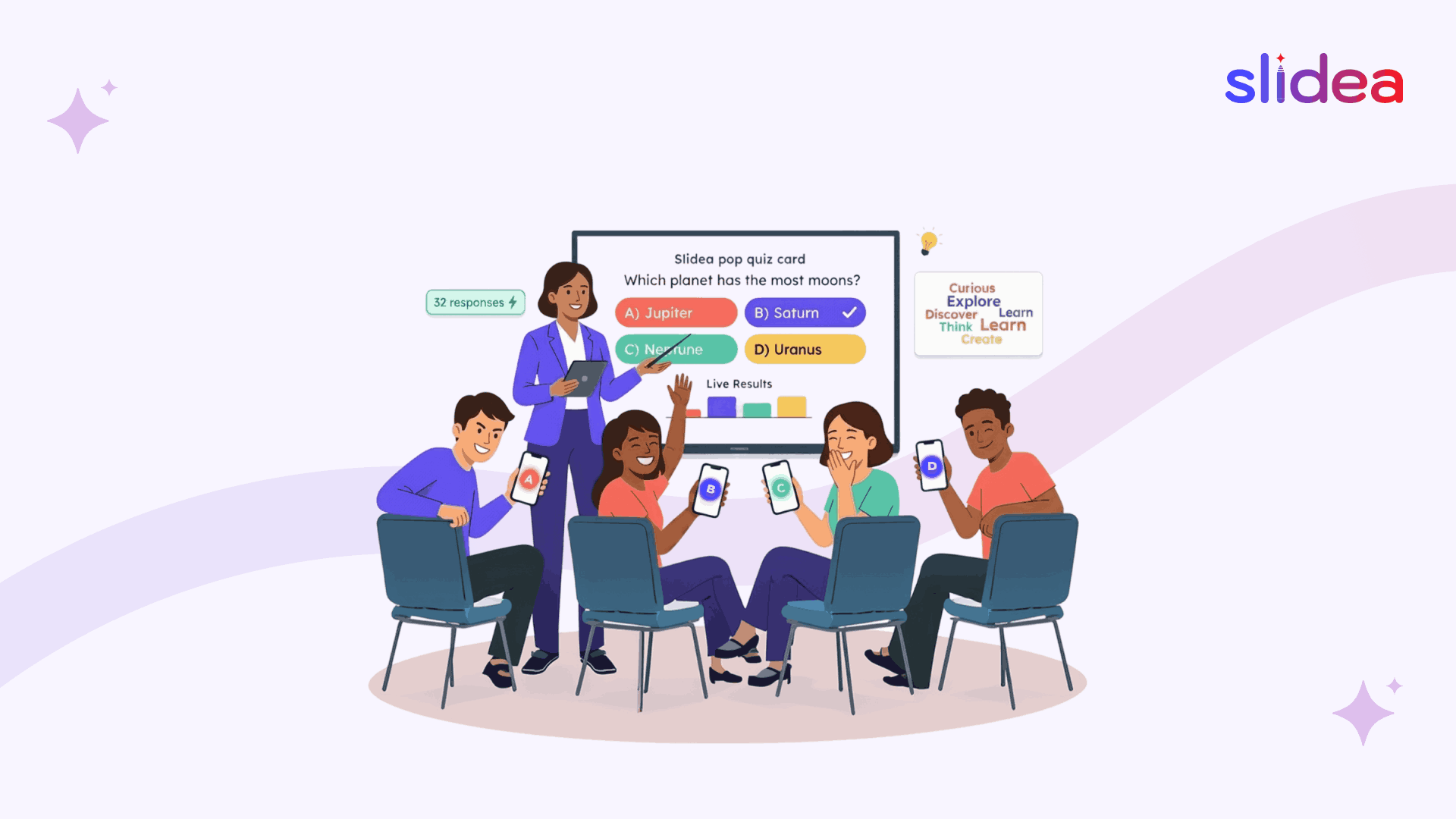
Slidea is an interactive learning platform built specifically to prevent that from happening. It turns every synchronous session into a genuinely two-way learning experience where every learner participates actively, not just listens passively.
Here is how Slidea's features address the real challenges and amplify the real benefits of synchronous learning:
| Slidea Feature | How It Works in a Synchronous Session | The Learning Outcome It Produces |
| Live Poll | The instructor posts a question at any point during the live session. Every learner responds from their own device in seconds and the results appear live on the shared screen for the whole group to see at the same time. | The instructor gets an instant read on where the group stands on a topic and can adjust the pace, revisit a concept, or move forward confidently based on the live responses. |
| Word Cloud | The instructor asks a one-word prompt like “Give one word for the biggest challenge you face with this topic,” and every learner responds simultaneously. The words build into a live visual display as responses come in. | Honest learner thoughts surface immediately, helping instructors quickly understand what the group is thinking and feeling without requiring anyone to speak publicly. |
| Open-Ended Slide | The instructor poses a discussion question and every learner types a full response from their device at the same time. All answers appear live on screen for the group to read together. | Every learner contributes simultaneously, creating richer discussion, broader participation, and more collaborative learning moments. |
| Quiz Slides | The instructor can run multiple quiz formats including multiple choice questions, typed answers, number-based questions, and sequencing activities. Learners respond directly from their devices while results appear live on screen. | Quiz slides make understanding visible in real time by testing recall, comprehension, sequencing, and decision-making, helping instructors instantly identify learning gaps and reinforce concepts before moving ahead. |
| Rating Slide | The instructor asks learners to rate their confidence or clarity on a topic from one to ten. Responses appear instantly as a live average on screen. | The instructor gets a real-time pulse check on learner confidence and can immediately adjust explanations or revisit difficult topics when needed. |
| Q and A Slide | Learners submit questions anonymously from their devices during the live session. Questions appear in a shared feed and participants can upvote the ones they most want answered. | Creates psychological safety by encouraging every learner to ask questions openly, including the ones they may hesitate to ask aloud. |
| Traffic Light Slide | Learners respond with green for fully understood, yellow for partially understood, and red for confusion directly from their own devices. The results appear instantly on screen. | Gives instructors a fast and compassionate understanding of group comprehension without putting individual learners on the spot. |
| Annotation Tool | The instructor highlights, circles, or draws directly on shared content during live explanations, with annotations appearing instantly for all learners. | Visual emphasis improves clarity, keeps learners engaged, and helps make abstract concepts easier to understand in live virtual sessions. |
Final Thoughts
Synchronous learning remains one of the most powerful ways to teach, train, and learn because it brings people together in the same moment. The ability to ask questions instantly, discuss ideas live, collaborate in real time, and react together creates an energy and connection that self-paced learning alone cannot fully replace.
At the same time, modern synchronous learning is no longer limited to traditional classrooms. It now happens across virtual meetings, webinars, hybrid events, online workshops, and corporate training sessions worldwide. The challenge is not simply getting people into the same session, it is keeping them actively engaged once they are there.
That is where interactive learning tools make the biggest difference. When learners can participate through live polls, quizzes, word clouds, Q&A sessions, and collaborative activities, synchronous learning becomes more than a live presentation. It becomes a genuinely shared learning experience where every learner contributes, responds, and stays connected throughout the session.
The future of effective learning is not choosing between synchronous and asynchronous methods. It is knowing when to use each one, and designing live sessions that make real-time participation feel valuable, inclusive, and memorable for everyone involved.
FAQs
Q1. What is synchronous learning in simple words?
Synchronous learning is a type of learning where instructors and learners interact in real time at the same moment. This can happen in physical classrooms, live online classes, webinars, workshops, or virtual meetings.
Q2. What is the difference between synchronous and asynchronous learning?
Synchronous learning happens live with immediate interaction and feedback, while asynchronous learning allows learners to study at their own pace using recorded lessons, discussion boards, or self-paced materials.
Q3. What are examples of synchronous learning?
Common examples include live classroom lessons, Zoom training sessions, webinars, virtual workshops, online tutoring, hybrid learning sessions, and real-time team training meetings.
Q4. What are the main benefits of synchronous learning?
Synchronous learning improves real-time communication, collaboration, immediate feedback, audience engagement, accountability, and group discussion, making learning feel more interactive and connected.
Q5. What are the challenges of synchronous learning?
Some common challenges include scheduling conflicts, technology issues, different learning speeds among participants, passive participation in large groups, and difficulty accommodating learners across multiple time zones.



Your email address will not be published. Required fields are marked *