


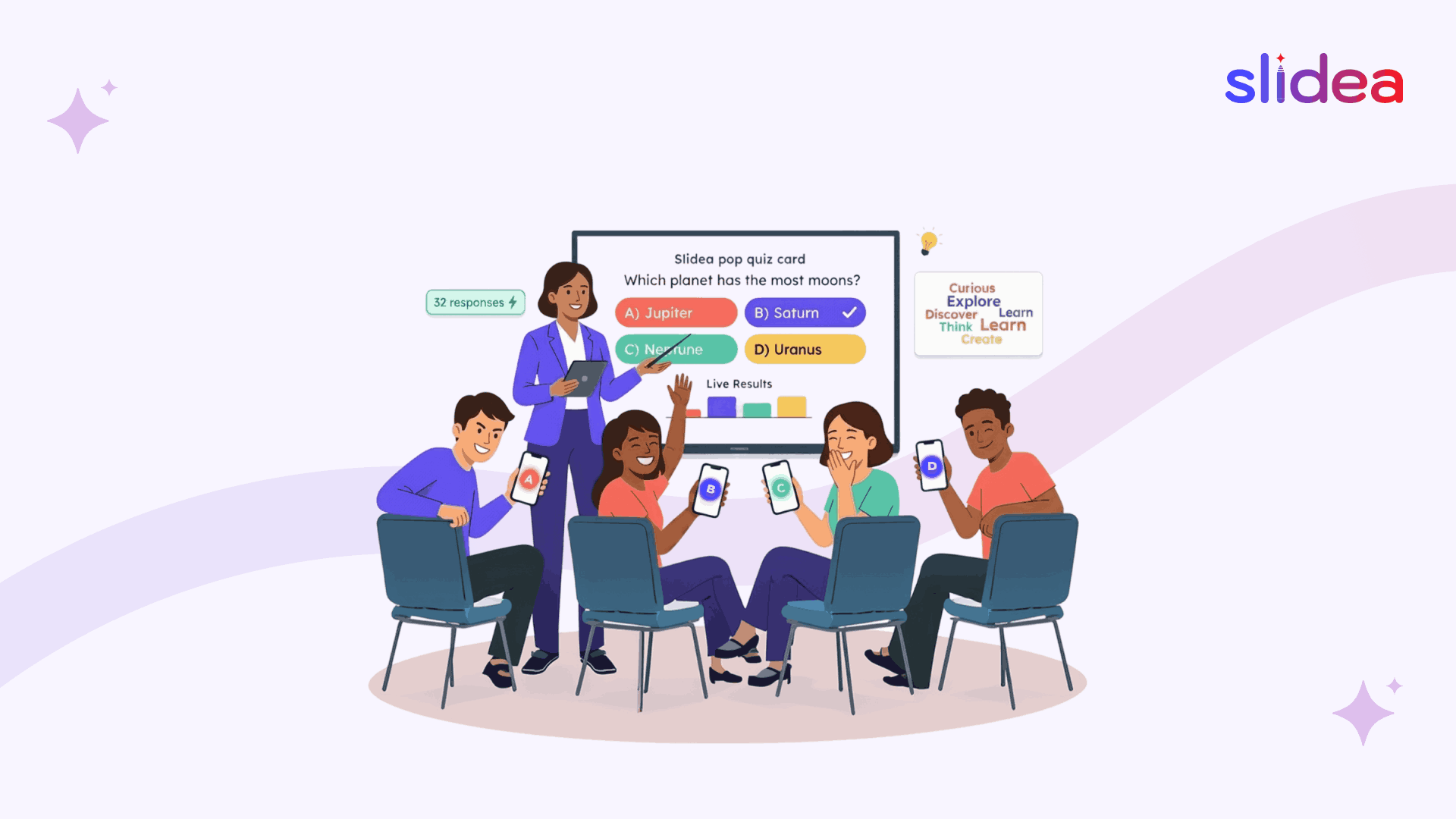
Class usually starts the same way. Students open their notebooks. Someone asks, “Will this be on the test?” A few students look at their phones. Before long, many students lose focus before the lesson even begins.
The problem is not the lesson. It is the lack of energy at the start. When students are not interested early, it becomes harder for them to stay focused later. That is where a good pop quiz can help, not as a punishment, but as a simple way to get students thinking quickly.
When you combine these quiz ideas with interactive presentation software, it becomes easier for every student to participate, respond instantly, and stay involved throughout the session.
Below, you will find quiz formats grouped by classroom type, learning goal, and activity level. From small group discussions to large lecture halls, there is a format here that can fit your teaching style.
“When students answer a question early, even a fun one, they are more likely to stay focused and think more deeply during the lesson.”
Why Pop Quizzes Help Learning, Not Just Grades
Many teachers see quizzes only as a way to check student progress. But when quizzes are made to be fun and engaging, they also help students remember better and participate more in class.
When students try to remember an answer, even if they do not get it completely right, they learn it better than by simply reading notes again. This learning method is called the “testing effect,” and it is one of the most trusted ideas in education research. A pop quiz not only checks learning, but it also improves it.
In large classrooms or online classes, where teachers cannot give personal attention to every student, short quizzes become even more useful. They remind students that everyone should stay involved and think actively during the lesson, not just sit and listen.
Even a quick three-minute quiz at the beginning of class can change the mood of a full lesson and help students focus again.
01 — Quick Recall Quizzes (Under 3 Minutes)
Simple Quiz Ideas to Start a Lesson
These quiz ideas are great when you only have a few minutes but still want students to start thinking before the lesson begins. Choose one activity, keep it quick, and continue with the class. Even a short activity can help students focus better.
- Ask one true-or-false question from the previous class
- Give a fill-in-the-blank sentence with one missing keyword
- Ask students to name three things they remember from last week’s lesson
- Ask: “What is one thing you still do not understand from the last topic?”
- Match a word to its meaning using hand signals or a whiteboard
- Ask students to explain today’s topic in one simple sentence before the lesson starts
- Use thumbs up or thumbs down for the question: “Have you learned this idea before?”
- Show two answers on the board and ask students to choose the correct one
02 — Conceptual Quizzes (For Better Understanding)
Questions That Help Students Think More Deeply
These quiz ideas work well in the middle of a lesson or unit, when students already know the basics but still need to understand the ideas more clearly. These questions focus more on understanding than just memorizing answers. They are especially useful in science, social studies, literature, and discussion-based classes.
- Why does this idea work? Explain in two simple sentences
- What is the difference between these two ideas? Give one example for each
- Which situation correctly uses the theory we learned about?
- If one condition changed, what do you think would happen and why?
- Put these ideas in order from most important to least important, and explain your first choice
- Give one real-life example where this concept can be used directly
03 — Team Quizzes (Build Teamwork)
Group Quiz Ideas That Make Learning More Interactive
These quiz activities help students learn together, not only from the teacher. When students discuss answers in groups, even quieter students feel more comfortable sharing their ideas. These activities work very well in workshops, revision classes, and group learning sessions.
- Work in pairs and ask each other three questions you create yourselves
- Group challenge: each table gets a different question and explains the answer to the class
- Quiz relay: students pass a question sheet around, and each person answers one question before passing it on
- Defend your answer: one student answers while their partner explains the opposite side
- Quick brain dump: groups write down everything they know about a topic in 90 seconds
- Quiz bowl game: teams earn points by answering questions in a fun competition
- Find the mistake: groups are answered with one wrong part and must identify the error
04 — Digital & Interactive Quizzes (For Online and Hybrid Classes)
Quiz Ideas That Keep Online Students Involved
In online and hybrid classes, students can easily lose focus if there is not enough interaction. These digital quiz ideas help keep everyone involved and make students feel connected, even when they are learning from different places.
- Live multiple-choice poll where results appear instantly as a chart or graph
- Word cloud activity: “What is the first word you think of when you hear this topic?”
- Open text answers where everyone types a response, and the best answers are shared without names
- Timed quiz game with a leaderboard to add some fun competition
- Confidence slider: “How confident do you feel about this topic from 1 to 5?”
- Reaction quiz where students use emojis or icons to show their understanding
- Exit ticket survey: one quick question before students leave the online class to check what they learned
05 — Creative & Fun Quiz Formats (For Active Classrooms)
Quiz Ideas That Make Students Think and Enjoy Learning
Sometimes, using a different type of quiz can make a lesson more exciting and memorable. These activities encourage students to think creatively and help shy or hesitant learners feel more comfortable joining in, because there is not always one correct answer.
- Would you rather (learning version): “Would you rather explain photosynthesis or the water cycle to a young child?”
- Tweet it: explain the whole lesson in 280 characters or less
- Emoji challenge: use only three emojis to describe a concept, then explain your choices
- Reverse quiz: students create the question for a given answer
- Teach it back: one student explains a topic to the class as if they discovered it themselves
- Opinion challenge: students share their opinion about the topic and explain it in 30 seconds
- Analogy activity: “This concept is like ______ because ______.” Complete the sentence with your own idea
06 — 5 Simple Tips for Running Pop Quizzes Successfully
1. Use Only One Quiz Style in Each Class
Do not use too many quiz activities in one session. Pick one format, keep it simple, and continue with the lesson. Around 2 to 5 minutes is usually enough. If it goes on too long, students may start feeling like they are taking a real test.
2. Choose the Right Quiz for the Right Time
Different quiz styles work better at different times. A quick recall quiz is great at the beginning of class. A deeper thinking question works well in the middle of a topic. Creative quizzes are useful at the end of a lesson to review learning in a fun way.
3. Help Students Feel Comfortable Participating
Students join in more when they are not afraid of making mistakes. Present the quiz as a learning activity, not as a strict test. Appreciate students for trying, not only for getting the correct answer.
4. Change Quiz Formats Often
Using the same quiz every week can become boring. Keep a few different quiz ideas ready and switch between them. Trying something new keeps students interested and excited.
5. Make It Easy for Everyone to Participate
Instead of asking students one by one, use classroom response tools that allow everyone to answer at the same time. When answers appear live on the screen, even quiet students feel more included. This works especially well in large classrooms and online classes.
Final Thoughts
Learning does not have to be boring or passive. The way a class starts, or the moment a teacher pauses to ask a question, can make a big difference in how much students learn and remember. Pop quizzes are not meant to surprise or scare students. They are meant to help students think actively. When students answer a question early in the lesson, they stay more focused, remember information better, and feel more connected to the class.
You do not need complicated tools or difficult systems to make this work. Sometimes, one good question at the right time is enough to change the energy of the whole classroom. Start by trying one quiz idea from this list and see how students react. Next week, try a different format. Over time, these small activities can help create a classroom where students feel comfortable sharing ideas, trying new things, and staying curious. Even quiet classrooms are full of smart students. Sometimes, they just need the right question to start speaking and thinking openly.
FAQs
1. What is a pop quiz?
A pop quiz is a short quiz given during a class without much warning. It helps students stay focused, remember what they learned, and helps teachers quickly check student understanding without giving a big test.
2. How long should a pop quiz be?
A pop quiz should usually take about 2 to 5 minutes. The purpose is to help students think and review quickly, not to take up the whole lesson. Keep it short and simple.
3. Do pop quizzes really help students learn?
Yes. Studies show that when students try to remember information from memory, they learn and remember it better than by only reading notes again. Even small quizzes can improve long-term learning.
4. What quiz formats work best for online classes?
Live polls, word clouds, open-text answers, and confidence rating sliders work very well in online classes. These activities allow all students to answer at the same time without needing to speak one by one.
5. Should pop quizzes be graded?
Not always. Quizzes without grades often make students feel more relaxed and willing to participate honestly. If you do give grades, keep them small, so students focus more on learning and less on stress about marks.





Your email address will not be published. Required fields are marked *