


Here is something that surprises most people the first time they hear it, not every quiz question has just one right answer. In fact, some of the best quiz questions in the world have two, three, or even four correct answers at the same time. And the moment you introduce that kind of question into your quiz night, classroom, or team session, everything changes.
Suddenly people are not just guessing. They are thinking, and debating. They are saying "Wait, that one is also correct!" And that kind of reaction is exactly what makes a quiz truly memorable.
Multiple correct answer questions are one of the most underused tools in quizzing. They test deeper understanding, reward careful thinking, and create much richer discussions than a standard single-answer question ever could. They work brilliantly in classrooms, corporate training sessions, pub quiz nights, virtual meetings, and hybrid events.
And when you run them on a smart interactive quiz platform, where participants can select more than one answer at a time and see live results on screen, the experience becomes something your audience will genuinely remember.
In this blog, you will find 100 quiz questions with multiple correct answers, sorted by category, with clear explanations for every single one.
What Are Multiple Correct Answer Quiz Questions?
A multiple correct answer question is a quiz question where two or more of the given options are correct. Unlike a standard multiple choice question where only one option is right, these questions ask participants to identify all the correct answers from a list.
For example: "Which of these are mammals?" with options like Dog, Shark, Dolphin, Eagle, and Whale. The correct answers are Dog, Dolphin, and Whale. Someone who only picks one correct answer gets partial credit. Someone who finds all three shows a deeper level of understanding.
These questions are popular in school exams, professional certifications, corporate training assessments, and quiz competitions because they cannot be answered correctly by guessing one option. They require the person to actually think through every choice carefully, which makes them a far more accurate test of real knowledge.
They also create amazing moments in group settings because different people spot different correct answers, and comparing answers leads to genuine, enthusiastic discussion every single time.
Quiz Questions with Multiple Correct Answers
Category 1: Science and Nature
- Which of these are planets in our solar system?
a) Mars b) Pluto c) Saturn d) Neptune
Correct Answers: a, c, d
Explanation: Mars, Saturn, and Neptune are all official planets. Pluto was reclassified as a dwarf planet in 2006 by the International Astronomical Union, so it no longer counts as a full planet.
- Which of these animals are mammals?
a) Dolphin b) Shark c) Bat d) Whale
Correct Answers: a, c, d
Explanation: Dolphins, bats, and whales are all mammals, they breathe air, give birth to live young, and nurse with milk. Sharks are fish, not mammals.
- Which of these are forms of renewable energy?
a) Solar b) Coal c) Wind d) Hydropower
Correct Answers: a, c, d
Explanation: Solar, wind, and hydropower are all renewable because they come from naturally replenishing sources. Coal is a fossil fuel and is non-renewable.
- Which of these gases are found in Earth's atmosphere?
a) Nitrogen b) Oxygen c) Hydrogen d) Argon
Correct Answers: a, b, d
Explanation: Nitrogen makes up about 78%, oxygen about 21%, and argon about 1% of Earth's atmosphere. Hydrogen exists in tiny trace amounts but is not considered a significant component.
- Which of these are types of rocks?
a) Igneous b) Plasma c) Sedimentary d) Metamorphic
Correct Answers: a, c, d
Explanation: The three main rock types are igneous, sedimentary, and metamorphic. Plasma is one of the four states of matter, not a type of rock.
- Which of these are parts of a plant cell but not an animal cell?
a) Cell wall b) Nucleus c) Chloroplast d) Vacuole
Correct Answers: a, c
Explanation: Cell walls and chloroplasts are found in plant cells but not in animal cells. Both plant and animal cells have a nucleus and vacuoles, though plant vacuoles are much larger.
- Which of these are considered warm-blooded animals?
a) Birds b) Crocodiles c) Dogs d) Snakes
Correct Answers: a, c
Explanation: Birds and dogs are warm-blooded, meaning they regulate their own body temperature. Crocodiles and snakes are cold-blooded reptiles whose body temperature depends on the environment.
- Which of these are examples of chemical changes?
a) Burning wood b) Melting ice c) Rusting iron d) Cooking an egg
Correct Answers: a, c, d
Explanation: Burning, rusting, and cooking all involve chemical reactions that create new substances. Melting ice is a physical change, the water molecules stay the same, just in a different state.
- Which of these are layers of the Earth?
a) Mantle b) Troposphere c) Crust d) Core
Correct Answers: a, c, d
Explanation: The Earth has four main layers, the crust, mantle, outer core, and inner core. The troposphere is a layer of Earth's atmosphere, not the Earth itself.
- Which of these are types of clouds?
a) Cumulus b) Stratus c) Nimbus d) Cirrus
Correct Answers: a, b, c, d
Explanation: All four are real cloud types. Cumulus are the big puffy ones, stratus are flat layered clouds, nimbus are rain clouds, and cirrus are the thin wispy high-altitude clouds.
- Which of these foods are high in protein?
a) Chicken b) Rice c) Eggs d) Lentils
Correct Answers: a, c, d
Explanation: Chicken, eggs, and lentils are all excellent sources of protein. Rice is primarily a carbohydrate with only a small amount of protein per serving.
- Which of these are examples of Newton's Laws of Motion in action?
a) A ball rolling to a stop b) A rocket launching c) A car braking d) A magnet attracting iron
Correct Answers: a, b, c
Explanation: Rolling to a stop, rocket launching, and braking all demonstrate Newton's laws of motion, inertia, force equals mass times acceleration, and action-reaction. Magnetism is governed by electromagnetic laws, not Newton's laws.
- Which of these are bones in the human body?
a) Femur b) Tibia c) Aorta d) Sternum
Correct Answers: a, b, d
Explanation: The femur, tibia, and sternum are all bones. The aorta is the largest artery in the human body, it carries blood, not structure.
- Which of these are types of energy?
a) Kinetic b) Thermal c) Atomic d) Potential
Correct Answers: a, b, d
Explanation: Kinetic, thermal, and potential are all recognized forms of energy. Atomic is not a standard energy category, the correct term is nuclear energy.
- Which of these are examples of ecosystems?
a) Desert b) Library c) Coral reef d) Rainforest
Correct Answers: a, c, d
Explanation: Deserts, coral reefs, and rainforests are all ecosystems, communities of living organisms interacting with their environment. A library is a human-made structure, not an ecosystem.
- Which of these are symptoms commonly associated with dehydration?
a) Headache b) Dark urine c) Fever d) Dizziness
Correct Answers: a, b, d
Explanation: Headache, dark urine, and dizziness are classic signs of dehydration. Fever is caused by infection or inflammation, not directly by lack of water.
- Which of these are types of volcanoes?
a) Shield b) Composite c) Plateau d) Cinder cone
Correct Answers: a, b, d
Explanation: Shield, composite, and cinder cone are all recognized volcano types. A plateau is a flat elevated landform, not a type of volcano.
- Which of these are examples of biodiversity?
a) Different species of birds b) Varieties of plants c) Multiple rock formations d) Different breeds of dogs
Correct Answers: a, b, d
Explanation: Biodiversity refers to the variety of living organisms. Birds, plants, and dog breeds all represent biological diversity. Rock formations are geological, not biological.
- Which of these are functions of the human liver?
a) Producing bile b) Filtering blood c) Pumping oxygen d) Breaking down toxins
Correct Answers: a, b, d
Explanation: The liver produces bile, filters blood, and breaks down toxins. Pumping oxygen is the job of the heart and lungs, not the liver.
- Which of these planets have moons?
a) Earth b) Mars c) Mercury d) Jupiter
Correct Answers: a, b, d
Explanation: Earth has one moon, Mars has two, and Jupiter has dozens. Mercury and Venus are the only two planets in our solar system with no moons at all.
Looking for more challenges? Check out the science quiz questions with answers to test your knowledge even further.
Category 2: History and Geography
- Which of these countries were part of the Allied Powers in World War Two?
a) USA b) Germany c) UK d) Soviet Union
Correct Answers: a, c, d
Explanation: The USA, UK, and Soviet Union were all Allied Powers. Germany was part of the Axis Powers along with Italy and Japan.
- Which of these are countries in South America?
a) Brazil b) Colombia c) Mexico d) Argentina
Correct Answers: a, b, d
Explanation: Brazil, Colombia, and Argentina are all in South America. Mexico is in North America.
- Which of these cities have hosted the Summer Olympics?
a) Tokyo b) Paris c) Dubai d) Sydney
Correct Answers: a, b, d
Explanation: Tokyo, Paris, and Sydney have all hosted the Summer Olympics. Dubai has never hosted the Olympic Games.
- Which of these are rivers in Africa?
a) Nile b) Amazon c) Congo d) Niger
Correct Answers: a, c, d
Explanation: The Nile, Congo, and Niger are all major African rivers. The Amazon is in South America.
- Which of these were ancient civilizations?
a) Mesopotamia b) Roman Empire c) Silicon Valley d) Indus Valley
Correct Answers: a, b, d
Explanation: Mesopotamia, the Roman Empire, and the Indus Valley are all ancient civilizations. Silicon Valley is a modern technology hub in California.
- Which of these are countries in the European Union?
a) Germany b) Norway c) France d) Spain
Correct Answers: a, c, d
Explanation: Germany, France, and Spain are EU member states. Norway is in Europe but is not a member of the European Union.
- Which of these landmarks are in Asia?
a) Taj Mahal b) Great Wall of China c) Eiffel Tower d) Angkor Wat
Correct Answers: a, b, d
Explanation: The Taj Mahal is in India, the Great Wall is in China, and Angkor Wat is in Cambodia, all in Asia. The Eiffel Tower is in Paris, France.
- Which of these were the causes of the First World War?
a) Assassination of Archduke Franz Ferdinand b) Invasion of Pearl Harbor c) Nationalism d) Alliance systems
Correct Answers: a, c, d
Explanation: The assassination of Franz Ferdinand, rising nationalism, and complex alliance systems all contributed to World War One. The attack on Pearl Harbor happened in 1941 and was connected to World War Two.
- Which of these are landlocked countries?
a) Switzerland b) Bolivia c) Portugal d) Hungary
Correct Answers: a, b, d
Explanation: Switzerland, Bolivia, and Hungary are all landlocked, they have no coastline. Portugal borders the Atlantic Ocean.
- Which of these are official languages of the United Nations?
a) English b) Spanish c) Hindi d) Arabic
Correct Answers: a, b, d
Explanation: English, Spanish, and Arabic are among the six official UN languages, the others being French, Russian, and Chinese. Hindi is not an official UN language.
- Which of these mountains are part of the Himalayas?
a) Mount Everest b) K2 c) Mont Blanc d) Kangchenjunga
Correct Answers: a, d
Explanation: Mount Everest and Kangchenjunga are both in the Himalayan range. K2 is in the Karakoram range, and Mont Blanc is in the Alps.
- Which of these were US Presidents during the 20th century?
a) Abraham Lincoln b) Franklin D. Roosevelt c) John F. Kennedy d) George Washington
Correct Answers: b, c
Explanation: Franklin D. Roosevelt served from 1933 to 1945, and John F. Kennedy served from 1961 to 1963, both in the 20th century. Lincoln served in the 19th century, and Washington served in the 18th century.
- Which of these are island countries?
a) Japan b) Iceland c) Austria d) New Zealand
Correct Answers: a, b, d
Explanation: Japan, Iceland, and New Zealand are all island countries surrounded by ocean. Austria is a landlocked country in central Europe.
- Which of these were outcomes of the French Revolution?
a) Rise of Napoleon b) Abolition of the monarchy c) Industrial Revolution d) Declaration of the Rights of Man
Correct Answers: a, b, d
Explanation: The French Revolution led to Napoleon's rise, the end of the monarchy, and the Declaration of the Rights of Man. The Industrial Revolution was a separate economic and technological movement.
- Which of these oceans border the continent of Africa?
a) Atlantic b) Indian c) Pacific d) Arctic
Correct Answers: a, b
Explanation: Africa is bordered by the Atlantic Ocean on the west and the Indian Ocean on the east. The Pacific and Arctic oceans do not touch Africa.
- Which of these were involved in the Cold War?
a) USA b) Soviet Union c) China d) India
Correct Answers: a, b
Explanation: The Cold War was primarily between the USA and the Soviet Union. While China and India were affected by Cold War tensions, they were not the central powers of the conflict.
- Which of these are deserts?
a) Sahara b) Gobi c) Amazon d) Atacama
Correct Answers: a, b, d
Explanation: The Sahara, Gobi, and Atacama are all deserts. The Amazon is a tropical rainforest, not a desert.
- Which of these are Scandinavian countries?
a) Norway b) Finland c) Denmark d) Netherlands
Correct Answers: a, c
Explanation: Norway and Denmark are traditionally Scandinavian. Finland is sometimes included in broader Nordic groupings but is not always classified as Scandinavian. The Netherlands is in Western Europe.
- Which of these are examples of ancient wonders?
a) Great Pyramid of Giza b) Colosseum c) Statue of Zeus d) Hanging Gardens of Babylon
Correct Answers: a, c, d
Explanation: The Great Pyramid of Giza, Statue of Zeus, and Hanging Gardens of Babylon are all on the original Seven Wonders of the Ancient World list. The Colosseum is a famous Roman structure but not part of the original seven wonders.
- Which of these countries have the Amazon River flowing through them?
a) Brazil b) Peru c) Chile d) Colombia
Correct Answers: a, b, d
Explanation: The Amazon flows through Brazil, Peru, and Colombia. Chile is on the Pacific coast of South America and the Amazon does not pass through it.
If you’d like to try a different challenge, explore the history quiz questions for students or test yourself with this geography trivia challenge with questions and answers, both featuring one-correct-answer formats.
Category 3: Pop Culture and Entertainment
- Which of these are Marvel superheroes?
a) Iron Man b) Batman c) Thor d) Black Widow
Correct Answers: a, c, d
Explanation: Iron Man, Thor, and Black Widow are all Marvel characters. Batman belongs to DC Comics.
- Which of these films won the Academy Award for Best Picture?
a) Titanic b) The Dark Knight c) Parasite d) Schindler's List
Correct Answers: a, c, d
Explanation: Titanic, Parasite, and Schindler's List all won Best Picture. The Dark Knight was famously not nominated for Best Picture despite its massive success.
- Which of these are music genres?
a) Jazz b) Manga c) Reggae d) Blues
Correct Answers: a, c, d
Explanation: Jazz, reggae, and blues are all music genres. Manga is a Japanese style of comic books and graphic novels, not music.
- Which of these are streaming platforms?
a) Netflix b) Spotify c) Hulu d) Disney Plus
Correct Answers: a, b, c, d
Explanation: All four are streaming platforms, Netflix, Hulu, and Disney Plus stream video content, while Spotify streams audio and music.
- Which of these are animated Disney movies?
a) The Lion King b) Toy Story c) Shrek d) Moana
Correct Answers: a, d
Explanation: The Lion King and Moana are Disney animated films. Toy Story is a Pixar film distributed by Disney, and Shrek is a DreamWorks production.
- Which of these are social media platforms?
a) Instagram b) LinkedIn c) Dropbox d) Pinterest
Correct Answers: a, b, d
Explanation: Instagram, LinkedIn, and Pinterest are social media platforms used for sharing content and connecting people. Dropbox is a cloud storage service, not a social media platform.
- Which of these musicians are known for pop music?
a) Taylor Swift b) Metallica c) Ariana Grande d) Bruno Mars
Correct Answers: a, c, d
Explanation: Taylor Swift, Ariana Grande, and Bruno Mars are all primarily known as pop artists. Metallica is a heavy metal band.
- Which of these are Harry Potter books?
a) The Goblet of Fire b) The Fellowship of the Ring c) The Chamber of Secrets d) The Half-Blood Prince
Correct Answers: a, c, d
Explanation: The Goblet of Fire, Chamber of Secrets, and Half-Blood Prince are all Harry Potter books. The Fellowship of the Ring is the first book in J.R.R. Tolkien's Lord of the Rings series.
- Which of these are video game consoles?
a) PlayStation b) Xbox c) Kindle d) Nintendo Switch
Correct Answers: a, b, d
Explanation: PlayStation, Xbox, and Nintendo Switch are all video game consoles. The Kindle is an e-reader made by Amazon.
- Which of these are award shows?
a) Grammy Awards b) Cannes Film Festival c) Golden Globes d) Super Bowl
Correct Answers: a, b, c
Explanation: The Grammy Awards, Cannes Film Festival, and Golden Globes are all entertainment award events. The Super Bowl is the NFL championship game, not an award show.
Love entertainment trivia? Check out the pop culture trivia questions and answers for even more exciting quiz ideas.
Category 4: Food, Sports, and General Knowledge
- Which of these sports are played on a court?
a) Tennis b) Basketball c) Cricket d) Badminton
Correct Answers: a, b, d
Explanation: Tennis, basketball, and badminton are all played on a court. Cricket is played on a pitch or oval field.
- Which of these are types of pasta?
a) Penne b) Risotto c) Fusilli d) Linguine
Correct Answers: a, c, d
Explanation: Penne, fusilli, and linguine are all types of pasta. Risotto is an Italian rice dish, not pasta.
- Which of these are Olympic sports?
a) Archery b) Chess c) Skateboarding d) Surfing
Correct Answers: a, c, d
Explanation: Archery, skateboarding, and surfing are all Olympic sports. Chess is not currently an Olympic sport, though there have been discussions about adding it.
- Which of these ingredients are in a classic Caesar salad?
a) Romaine lettuce b) Parmesan cheese c) Mozzarella d) Croutons
Correct Answers: a, b, d
Explanation: A classic Caesar salad contains romaine lettuce, Parmesan cheese, and croutons. Mozzarella is not a traditional Caesar salad ingredient.
- Which of these are contact sports?
a) Rugby b) Swimming c) Wrestling d) Boxing
Correct Answers: a, c, d
Explanation: Rugby, wrestling, and boxing all involve physical contact between players. Swimming is a non-contact sport.
- Which of these are types of cheese?
a) Cheddar b) Brie c) Tofu d) Gouda
Correct Answers: a, b, d
Explanation: Cheddar, Brie, and Gouda are all types of cheese. Tofu is made from soybeans and is not a cheese.
- Which of these countries are known for producing coffee?
a) Brazil b) Ethiopia c) Canada d) Colombia
Correct Answers: a, b, d
Explanation: Brazil, Ethiopia, and Colombia are among the world's top coffee producers. Canada is not known for coffee production due to its climate.
- Which of these are track and field events?
a) Long jump b) Shot put c) Pole vault d) Pommel horse
Correct Answers: a, b, c
Explanation: Long jump, shot put, and pole vault are all track and field events. The pommel horse is a gymnastics apparatus.
- Which of these are fermented foods?
a) Yogurt b) Kimchi c) White bread d) Sauerkraut
Correct Answers: a, b, d
Explanation: Yogurt, kimchi, and sauerkraut are all made through fermentation. White bread is baked, not fermented in the traditional sense.
- Which of these are team sports?
a) Volleyball b) Golf c) Football d) Hockey
Correct Answers: a, c, d
Explanation: Volleyball, football, and hockey are all team sports. Golf is primarily an individual sport, though team formats like the Ryder Cup do exist.
Keep the quiz going with more topics:
- Try these food trivia questions and answers for quiz games for delicious challenges
- Explore sports quiz questions on cricket, football, and more for action-packed fun
- Test yourself with general knowledge trivia questions for an all-round challenge
Category 5: Language, Math, and Logic
- Which of these are prime numbers?
a) 2 b) 4 c) 7 d) 13
Correct Answers: a, c, d
Explanation: 2, 7, and 13 are all prime numbers, they can only be divided by 1 and themselves. 4 is not prime because it can be divided by 2.
- Which of these are vowels in the English alphabet?
a) A b) E c) Y d) I
Answers: a, b, d
Explanation: A, E, and I are definite vowels in English. Y is sometimes considered a vowel depending on its use in a word, but it is primarily classified as a consonant.
- Which of these are examples of figurative language?
a) Metaphor b) Simile c) Noun d) Hyperbole
Correct Answers: a, b, d
Explanation: Metaphor, simile, and hyperbole are all figures of speech, types of figurative language. A noun is a part of speech, not a figure of language.
- Which of these are quadrilaterals?
a) Square b) Triangle c) Rectangle d) Trapezoid
Correct Answers: a, c, d
Explanation: Squares, rectangles, and trapezoids all have four sides, making them quadrilaterals. A triangle has three sides.
- Which of these are types of angles?
a) Acute b) Obtuse c) Parallel d) Reflex
Correct Answers: a, b, d
Explanation: Acute, obtuse, and reflex are all types of angles. Parallel describes lines that never meet, it is not a type of angle.
- Which of these words are synonyms of happy?
a) Joyful b) Melancholy c) Content d) Elated
Correct Answers: a, c, d
Explanation: Joyful, content, and elated all mean happy or pleased. Melancholy means sad or gloomy, the opposite of happy.
- Which of these are parts of speech in English?
a) Verb b) Paragraph c) Adjective d) Adverb
Correct Answers: a, c, d
Explanation: Verbs, adjectives, and adverbs are all parts of speech. A paragraph is a unit of writing, not a part of speech.
- Which of these numbers are divisible by 3?
a) 9 b) 14 c) 21 d) 33
Correct Answers: a, c, d
Explanation: 9 divided by 3 is 3, 21 divided by 3 is 7, and 33 divided by 3 is 11. 14 divided by 3 gives a remainder, so it is not divisible by 3.
- Which of these are types of triangles?
a) Scalene b) Isosceles c) Convex d) Equilateral
Correct Answers: a, b, d
Explanation: Scalene, isosceles, and equilateral are all types of triangles based on their sides. Convex describes a polygon where all interior angles point outward, it is not a triangle type.
- Which of these are punctuation marks?
a) Semicolon b) Apostrophe c) Conjunction d) Ellipsis
Correct Answers: a, b, d
Explanation: Semicolons, apostrophes, and ellipses are all punctuation marks used in writing. A conjunction is a connecting word, not a punctuation mark.
Category 6: Technology and the Modern World
- Which of these are programming languages?
a) Python b) Cobra c) JavaScript d) Ruby
Correct Answers: a, c, d
Explanation: Python, JavaScript, and Ruby are all real programming languages. Cobra is not a mainstream programming language.
- Which of these are input devices for a computer?
a) Keyboard b) Monitor c) Mouse d) Microphone
Correct Answers: a, c, d
Explanation: Keyboards, mice, and microphones are input devices, they send information to the computer. A monitor is an output device, it displays information from the computer.
- Which of these are examples of artificial intelligence in everyday life?
a) Voice assistants b) Spam filters c) Paper shredders d) Recommendation algorithms
Correct Answers: a, b, d
Explanation: Voice assistants, spam filters, and recommendation algorithms all use AI. A paper shredder is a purely mechanical device with no AI involved.
- Which of these are cloud storage services?
a) Google Drive b) Dropbox c) Adobe Photoshop d) OneDrive
Correct Answers: a, b, d
Explanation: Google Drive, Dropbox, and OneDrive are all cloud storage platforms. Adobe Photoshop is a photo editing software, not a storage service.
- Which of these are cybersecurity threats?
a) Phishing b) Malware c) Firewall d) Ransomware
Correct Answers: a, b, d
Explanation: Phishing, malware, and ransomware are all cybersecurity threats. A firewall is actually a security tool used to protect against threats, not a threat itself.
- Which of these are features of a smartphone?
a) GPS b) Camera c) Hard drive d) Touchscreen
Correct Answers: a, b, d
Explanation: GPS, cameras, and touchscreens are standard smartphone features. Hard drives are found in desktop and laptop computers, smartphones use flash storage instead.
- Which of these are web browsers?
a) Chrome b) Safari c) Bing d) Firefox
Correct Answers: a, b, d
Explanation: Chrome, Safari, and Firefox are all web browsers. Bing is a search engine made by Microsoft, not a browser.
- Which of these are social media marketing tools?
a) Hootsuite b) Canva c) Notepad d) Buffer
Correct Answers: a, b, d
Explanation: Hootsuite, Canva, and Buffer are all commonly used for social media marketing. Notepad is a basic text editor with no marketing functionality.
- Which of these are examples of wearable technology?
a) Smartwatch b) Fitness tracker c) Bluetooth speaker d) Smart glasses
Correct Answers: a, b, d
Explanation: Smartwatches, fitness trackers, and smart glasses are all worn on the body and qualify as wearable technology. A Bluetooth speaker is a portable device, not wearable.
- Which of these are types of internet connections?
a) Fiber optic b) DSL c) Bluetooth d) Satellite
Correct Answers: a, b, d
Explanation: Fiber optic, DSL, and satellite are all types of internet connections. Bluetooth is a short-range wireless communication technology, not an internet connection type.
Bonus Round: Mixed Category Questions
- Which of these are natural disasters?
a) Earthquake b) Flood c) Traffic jam d) Tsunami
Correct Answers: a, b, d
- Which of these are types of government?
a) Democracy b) Monarchy c) Capitalism d) Republic
Correct Answers: a, b, d
- Which of these are examples of renewable resources?
a) Sunlight b) Natural gas c) Wind d) Tidal energy
Correct Answers: a, c, d
- Which of these are primary colors in traditional art?
a) Red b) Green c) Blue d) Yellow
Correct Answers: a, c, d
- Which of these are types of poetry?
a) Haiku b) Sonnet c) Memoir d) Limerick
Correct Answers: a, b, d
- Which of these are examples of physical exercise?
a) Swimming b) Reading c) Cycling d) Yoga
Correct Answers: a, c, d
- Which of these are continents?
a) Africa b) Greenland c) Antarctica d) Europe
Correct Answers: a, c, d
- Which of these are types of maps?
a) Political b) Topographic c) Fictional d) Climate
Correct Answers: a, b, d
- Which of these are parts of the human digestive system?
a) Stomach b) Lungs c) Small intestine d) Esophagus
Correct Answers: a, c, d
- Which of these are examples of nonverbal communication?
a) Eye contact b) Tone of voice c) Body language d) Facial expressions
Correct Answers: a, c, d
- Which of these are types of calendars?
a) Gregorian b) Lunar c) Solar d) Digital
Correct Answers: a, b, c
- Which of these are examples of inflation effects?
a) Higher prices b) More jobs c) Reduced purchasing power d) Currency devaluation
Correct Answers: a, c, d
- Which of these are UNESCO World Heritage Sites?
a) Machu Picchu b) Times Square c) Great Barrier Reef d) Stonehenge
Correct Answers: a, c, d
- Which of these are types of logical fallacies?
a) Straw man b) Ad hominem c) Hypothesis d) Slippery slope
Correct Answers: a, b, d
- Which of these are examples of soft skills?
a) Communication b) Python coding c) Teamwork d) Empathy
Correct Answers: a, c, d
- Which of these are types of business models?
a) Subscription b) Franchise c) Longitude d) Freemium
Correct Answers: a, b, d
- Which of these are symptoms of stress?
a) Headaches b) Stronger memory c) Fatigue d) Irritability
Correct Answers: a, c, d
- Which of these are examples of visual art?
a) Sculpture b) Photography c) Opera d) Painting
Correct Answers: a, b, d
- Which of these are types of learning styles?
a) Visual b) Auditory c) Numerical d) Kinesthetic
Correct Answers: a, b, d
- Which of these are components of emotional intelligence?
a) Self-awareness b) Empathy c) Speed reading d) Self-regulation
Correct Answers: a, b, d
How Slidea Makes Multiple Correct Answer Quizzes More Exciting
Running a multiple correct answer quiz on paper or through a basic slideshow can be confusing for participants. How do they select more than one answer? How do you collect everyone's responses at the same time? How do you show the correct answers in a way that sparks discussion?
Slidea solves all of that, and makes the whole experience genuinely exciting. It is an interactive quiz platform built for real-time audience participation. Here is how it makes multiple correct answer quizzes better in every setting:
Select Answer Slide
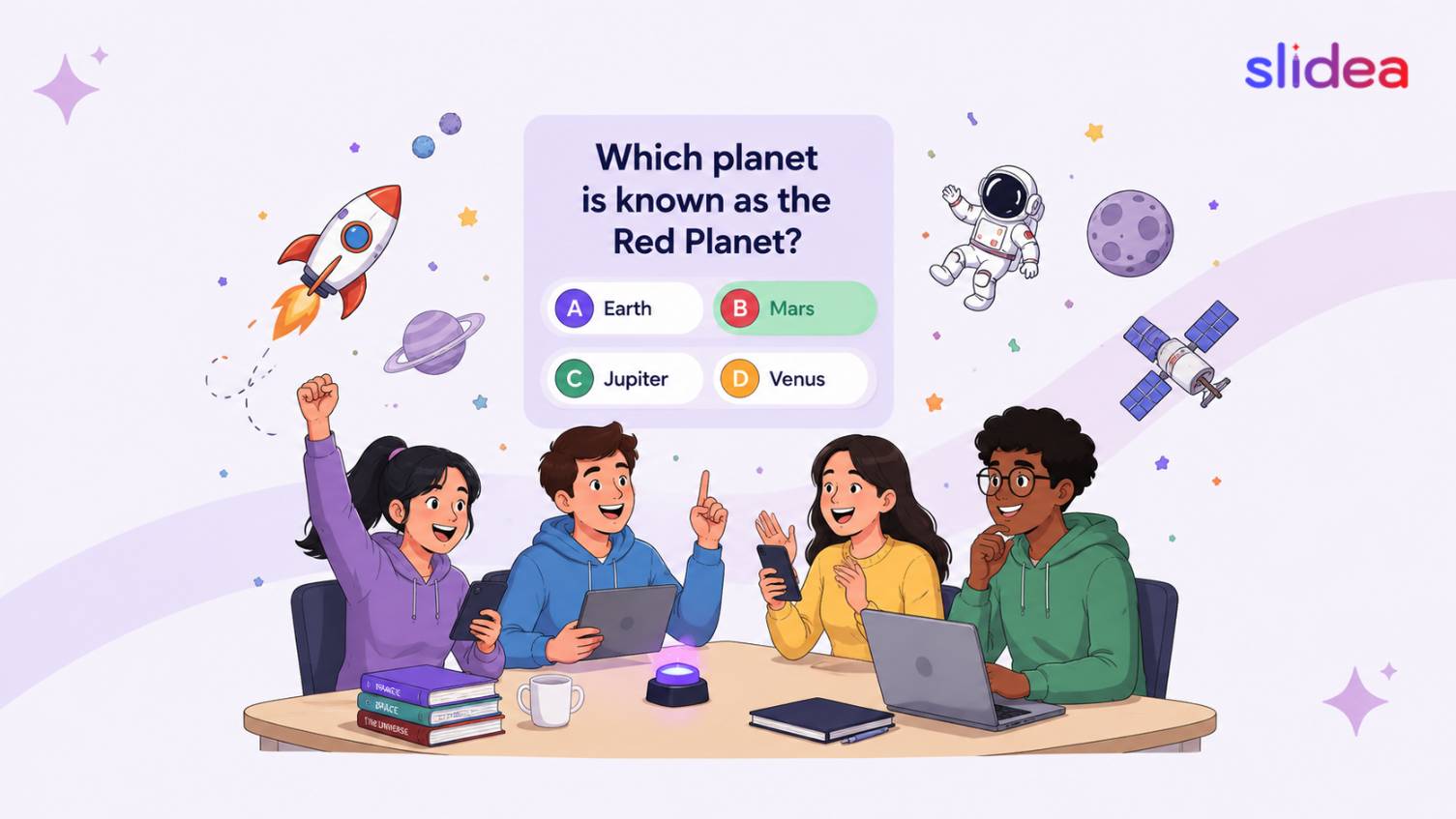
Slidea's quiz slide supports multiple correct answer questions natively. Participants see all the options on their screen and can tap or click more than one answer before submitting. The platform tracks scores, and response patterns, so you can see exactly how your audience answered and where the common mistakes were. It's clean, fast, and works perfectly for every question in this blog.
Live Results Display
After everyone submits their answers, Slidea shows a live breakdown of how the group responded, which options were selected most, which correct answers were missed, and how many people got all the right answers. This live results moment is always one of the most engaging parts of any quiz session. People lean in, compare their answers, and the discussion that follows is always rich and genuine.
Timer Feature
Add a countdown timer to each question that makes quizzes so exciting. Short timers work great for easier questions. Longer timers give participants enough time to think through every option carefully, which is especially important for multiple correct answer questions where rushing leads to missed answers.
Live Leaderboard and Champion Board
After each question, Slidea's live leaderboard shows who is on top, ranked by both accuracy and speed. At the end of the quiz, the champion board reveals the overall winner with a satisfying, celebratory reveal that always gets a big reaction from the room. It's the perfect way to close a quiz session on a high note.
Final Thoughts
Most quizzes end when someone shouts the right answer. But the best quizzes, the ones people talk about for days, are the ones that make people argue, debate, think twice, and say "Wait, that is also correct!"
That's exactly what multiple correct answer questions do. They do not just test what people know. They test how carefully people think. They reward the person who reads every option. They create moments where the whole group leans in together, compares answers, and genuinely learns something new.
And with Slidea, running them live, those moments become even bigger. The leaderboard builds competition. The live results build discussion. And the champion board brings every quiz to a close in the most satisfying way possible.
The next quiz you run does not have to be ordinary. Make it one where the answers surprise people, the discussion goes deep, and everyone walks away knowing something they did not know before.
FAQs
Q1. What are multiple correct answer questions and how are they different from regular multiple choice?
Regular multiple choice questions have one correct answer from a list of options. Multiple correct answer questions have two or more correct answers from the same list. They are harder to guess correctly because you have to identify every right answer, not just one.
Q2. How do you score multiple correct answer questions fairly?
There are different ways to score them. The most common method is all-or-nothing, you only get the point if you select all the correct answers and none of the wrong ones. Another method is partial scoring, you get credit for each correct answer you identify, minus points for any wrong answers you select.
Q3. Why are multiple correct answer questions better for learning?
Multiple correct answer questions make people think through every single option, not just stop at the first answer that seems right. This deeper engagement with the material leads to better retention and more genuine understanding. They also spark great discussion because different people often identify different correct answers, which leads to natural, enthusiastic debate about why each option is or isn't correct.
Q4. Can multiple correct answer quizzes work for virtual meetings and online events?
Absolutely. Multiple correct answer quizzes work brilliantly in virtual and hybrid settings. Using an interactive quiz platform like Slidea makes it seamless, every participant selects their answers from their own device, the results appear live on screen for everyone to see, and the discussion that follows happens naturally in the chat or on video. It keeps remote participants just as engaged as people in the room.






Your email address will not be published. Required fields are marked *