Exam Motivation Quotes For Students is an inspiring Slidea presentation designed to encourage learners to stay positive, build confidence, and approach exams with determination. It features uplifting messages and motivational quotes that remind students to believe in themselves, stay focused, and keep working toward their goals.
Section One, Believe in Yourself: Explore encouraging quotes about self-confidence, positive thinking, overcoming fear, and trusting your abilities.
Section Two, Stay Focused and Work Hard: Discover motivational messages about discipline, time management, preparation, consistency, and achieving academic goals.
Content mix: Inspirational quotes, motivational messages, positive affirmations, and encouragement for students preparing for exams.
Perfect for school students, college learners, teachers, educators, tutors, academic mentors, and parents who want to motivate students during exam preparation, classroom activities, study sessions, and educational events.
Present the slides from Slidea during classroom sessions, study workshops, morning assemblies, or exam preparation activities. Display each motivational quote and encourage students to reflect on its message. Teachers can invite learners to discuss their favorite quotes and share their personal study goals. You can also edit the text to include messages that suit your students.
Create a positive learning experience with Slidea's presentation templates. Pair this template with a study motivation presentation, student success quotes, or goal setting for students to encourage confidence, focus, and academic growth.
Is the Exam Motivation Quotes For Students template free?
Yes. You can use and edit the template on Slidea.
Who can use these exam motivation quotes?
School students, college students, teachers, tutors, and academic mentors can use these motivational messages.
When can teachers use this presentation?
It is suitable for exam preparation sessions, classroom activities, morning assemblies, study workshops, and motivational programs.
What topics do the quotes cover?
The suggested themes include confidence, hard work, discipline, focus, positive thinking, perseverance, and academic success.
Can I customize the motivational quotes?
Yes. You can edit the text and add your own motivational messages to match your students' needs.
Explore similar interactive templates
Explore all Education Templates →
Thermodynamics Quiz: Heat, Energy and the Four Laws is a free Slidea game that helps students review heat, temperature and energy transfer, with live answers from their phones and a leaderboard after every round. What's inside Round One, Heat and Temperature: the Kelvin scale, which way heat flows, absolute zero, conduction and convection. Round Two, The Four Laws: energy conservation, entropy, the zeroth law and thermal equilibrium, and the third law. Round Three, Engines and Everyday Heat: heat engines, refrigerators, latent heat, adiabatic processes and the joule. 15 timed Select Answer questions with a Championboard after every round, plus a warm-up Word Cloud, a This or That vote and a poll on the trickiest law, 28 slides in total. Who it's for: High school physics and chemistry teachers, first-year college students, engineering study groups, STEM clubs and tutors preparing learners for exams. How to play: Present from Slidea and share the join code. Each question runs for 20 seconds, and faster correct answers score more points. After each round, pause on any question the class missed and link it to a simple demo, such as ice melting in a warm hand. Every question can be edited to match your syllabus. More science games: Build your own round with Slidea's interactive quiz maker , cover wider topics with the physics quiz , switch subjects with the chemistry quiz , or find more ideas in these science quiz questions with answers . Frequently asked questions Is the Thermodynamics Quiz free? Yes. It is free to use and edit on Slidea, and players join from any phone, tablet or laptop without downloading an app. What level is it for? It suits high school and early college physics, and Round Three adds terms like latent heat and adiabatic that stretch stronger students. How long does the game take? About 15 minutes for all three rounds, or around five minutes if you play one round as a lesson starter.
Science Lesson Starter is a free Slidea warm-up for the first five minutes of class, where students bust common science myths, predict an experiment and answer a quick quiz on their phones. It gets every student thinking before the lesson begins and shows you what the class already knows. What's inside Part One, Spot the Science Myth: three Select Answer questions on the Moon, falling objects in a vacuum and what plants need, each with a 20-second timer and a leaderboard at the end. Part Two, Make a Prediction: a Multiple Choice poll where students predict what happens when zinc meets acid, then three questions on hydrogen, the boiling point of water and the center of an atom. Warm-up polls: an opening word cloud on what science means to students and a This or That vote on a famous lightning myth. Exit question: a closing word cloud where students share what they want to find out in today's lesson. Who it's for: middle and high school science teachers, chemistry and physics classes, homeschool groups, STEM clubs and tutors who want a quick, engaging bell ringer. How to run it: open the template, press Present and share the join code as students arrive. Run Part One as a warm-up, take predictions before your experiment, then use the final word cloud to set goals for the lesson. Every question, option and text box can be edited to match your own topic. More science ideas: try the general science quiz questions template or fifth grade life science , explore interactive classroom lessons , browse more interactive quizzes on Slidea , or pick up extra questions from our science quiz questions with answers . Frequently asked questions Is this science lesson starter free? Yes. The template is free to use and edit on Slidea, and students join from a phone, tablet or laptop without downloading an app. How long does the starter take? About five to ten minutes. You can run just Part One as a quick bell ringer and save the prediction round for the start of a practical. Can I change the experiment? Yes. Edit the prediction poll and Part Two questions to match any experiment or topic you are teaching that day.
Asynchronous Learning is a free Slidea class check-in that helps students understand self-paced study, test what they know and share how confident they feel learning on their own. It mixes quick quiz questions with polls and word clouds, so teachers see both scores and the class mood in one place. What's inside Part One, What Is Async Learning: three Select Answer questions on what asynchronous learning means, live versus self-paced activities and the main benefit, each with a 20-second timer and a leaderboard at the end. Part Two, Study Smarter On Your Own: planning self-paced work, the habit that helps a lesson stick and what to do first when you get stuck. Check-in polls: an opening word cloud on how students like to learn, a This or That vote on morning or evening study and a Multiple Choice confidence check. Reflection: a closing word cloud where learners share what would help them learn better online. Who it's for: online and hybrid classes, flipped classrooms, college courses, corporate e-learning programs, tutors and any teacher moving part of a course to self-paced study. How to run it: open the template, press Present and share the join code at the start of a self-paced unit or in a weekly catch-up session. Review the confidence poll and reflection word cloud afterwards to spot who needs extra support. Every question, option and text box can be edited to match your own course. More ideas for online classes: try the blended learning environment template , questions for remote learning or effective study habits for students , browse more interactive quizzes on Slidea , or read how interactive presentations improve remote learning . Frequently asked questions Is this asynchronous learning template free? Yes. The template is free to use and edit on Slidea, and students join from a phone, tablet or laptop without downloading an app. What is the difference between synchronous and asynchronous learning? Synchronous learning happens live at a set time, such as a video class, while asynchronous learning lets students work through lessons, videos and forums on their own schedule. When should I use this check-in? Use it at the start of a self-paced unit to set expectations, or at the end of a week to check understanding and confidence before moving on.
Slidea quiz template that turns everyday science into a live game kids can play from any phone or tablet. Players join with a code, answer in real time and watch the leaderboard update after each round. What's inside Round 1, Everyday Science: five questions on magnets, floating ice, rainbows, evaporation and gravity. Round 2, Kitchen Lab Experiments: five questions on baking soda and vinegar, yeast, salty water, static electricity and boiling water. Warm-ups and polls: a word cloud of dream experiments, a Volcano or Slime vote and a Which Scientist Would You Like to Be poll, plus a Championboard after each round. Who it's for: primary and middle school classes, STEM clubs, homeschool groups, science fairs and family game nights. The questions use simple words, and every wrong option is still about science, so kids keep learning while they guess. How to run it: open the template, click Present and share the join code. Each question runs for 20 seconds, and faster correct answers earn more points. Speaker notes give the correct answer and a short fact to read aloud. More to play: browse free interactive quizzes on Slidea , read these science trivia questions with answers , or try Fun Trivia for Kids , the Human Body Quiz and the Earth and Space Science template.
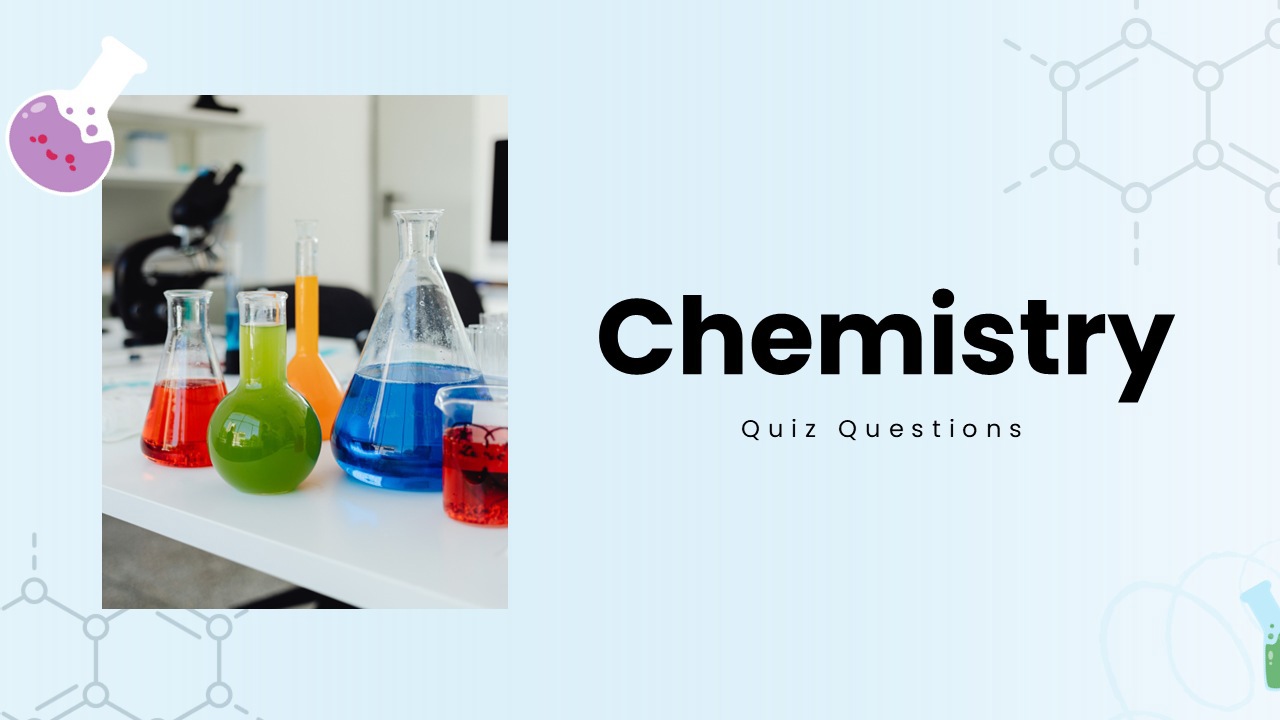
Ready to make chemistry fun and easy to understand? Easy Chemistry Questions helps learners test their knowledge through select-an-answer, type-an-answer, lineup, and pick-a-number activities. Perfect for school students, science teachers, chemistry tutors, and beginners.
Ready to create your own templates?
Get Started Free