


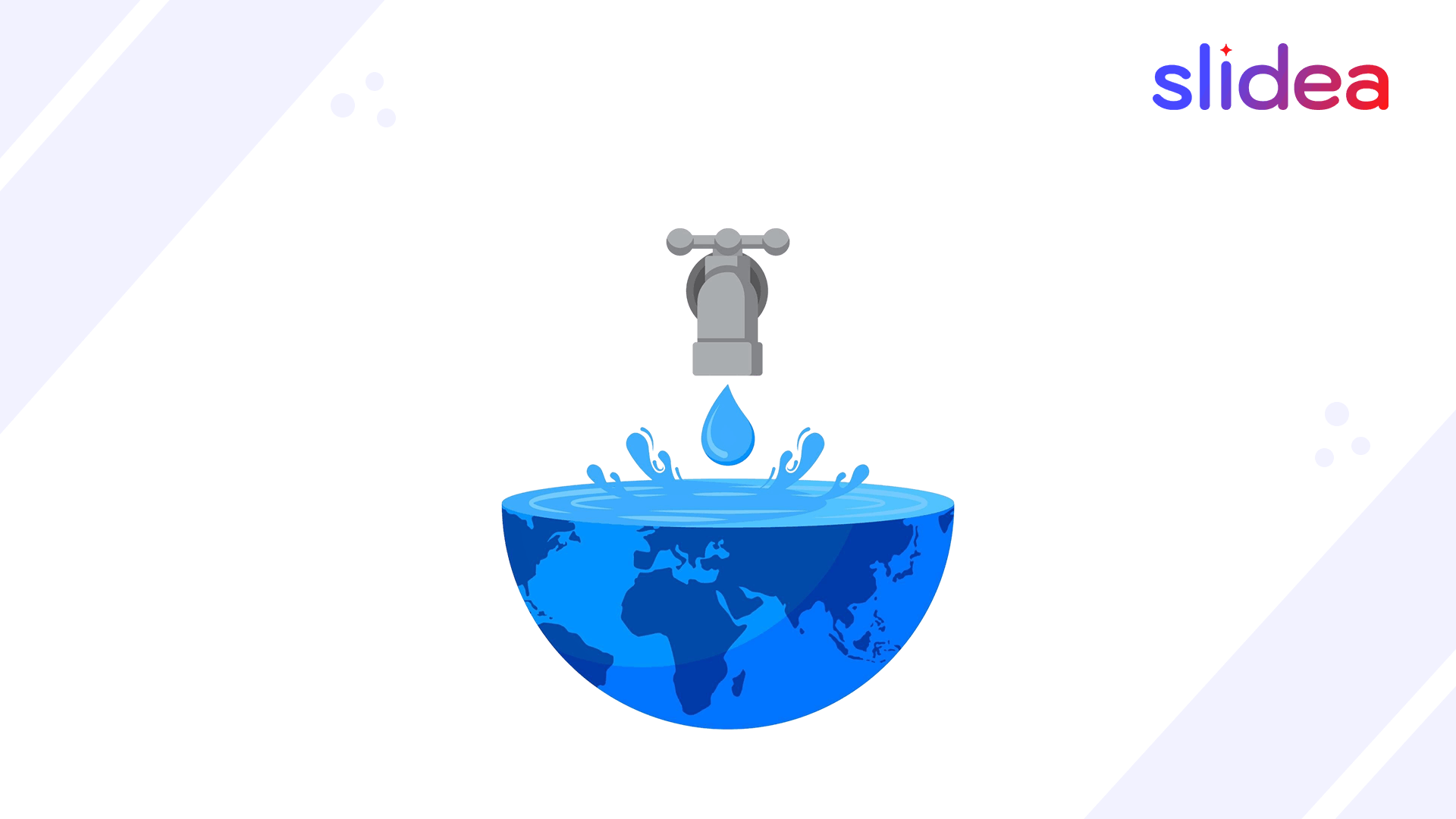
By 2025, half of the world’s population could be living in water-stressed areas. That means your students, the leaders of tomorrow will inherit a planet where water is one of the most precious resources we have.
World Water Day, celebrated every March 22nd, isn’t just another calendar date to acknowledge and move on from. It’s a crucial opportunity to educate students about water conservation, access challenges, and the science behind this life-sustaining resource. And what better way to engage young minds than through interactive quizzes that turn learning into an exciting challenge?
When you use an interactive quiz platform to deliver the questions, you transform passive water conservation lectures into active learning experiences where students compete, discover surprising facts, and genuinely internalize why every drop matters. Through live polls, quizzes, and real-time engagement, you can measure understanding while sparking conversations that extend far beyond the classroom.
What Is World Water Day?
World Water Day is celebrated every year on March 22. It focuses on raising awareness about the importance of freshwater and promoting sustainable water management.
Schools around the world use this day to organize quizzes, discussions, live polls, and word clouds to help students understand why water matters.
World Water Day Quiz Questions and Answers
Easy Questions (For Elementary Students)
- When is World Water Day celebrated?
Answer: March 22
- What percentage of the Earth is covered by water?
Answer: About 71%
- Is all water on Earth safe to drink?
Answer: No
- What is frozen water called?
Answer: Ice
- What do we call water that falls from the sky?
Answer: Rain
- What is the main source of drinking water?
Answer: Freshwater
- Which ocean is the largest?
Answer: Pacific Ocean
- What do plants need water for?
Answer: Growth
- What do we call saving water?
Answer: Water conservation
- Name one way to save water at home.
Answer: Turn off the tap while brushing
Medium Questions (For Middle School Students)
- What percentage of Earth’s water is freshwater?
Answer: About 3%
- What is the water cycle?
Answer: The continuous movement of water on Earth
- Name the three stages of the water cycle.
Answer: Evaporation, condensation, precipitation
- What is groundwater?
Answer: Water stored underground
- What is desalination?
Answer: Removing salt from seawater
- Which continent faces major water scarcity issues?
Answer: Africa
- What causes water pollution?
Answer: Waste, chemicals, and plastic
- What is a drought?
Answer: A long period without rain
- Why is clean water important?
Answer: For health and survival
- What organization leads World Water Day campaigns?
Answer: United Nations
Hard Questions (For High School Students)
- How much of Earth’s freshwater is locked in glaciers?
Answer: About 68%
- What is sustainable water management?
Answer: Using water responsibly to protect future supply
- What is wastewater treatment?
Answer: Cleaning used water before reuse or release
- What is the main cause of global water scarcity?
Answer: Climate change and overuse
- What is the SDG goal related to water?
Answer: Clean Water and Sanitation (SDG 6)
- What is virtual water?
Answer: Water used to produce goods
- What is rainwater harvesting?
Answer: Collecting and storing rainwater
- What is the water footprint?
Answer: Total water used by a person or product
- What is irrigation?
Answer: Supplying water to crops
- What gas is released during evaporation?
Answer: Water vapor
Fun & Awareness Questions
- How many liters of water should a person drink daily?
Answer: Around 2–3 liters
- Which country has the most freshwater resources?
Answer: Brazil
- What day is celebrated to raise awareness about water?
Answer: World Water Day
- What is the largest freshwater lake by volume?
Answer: Lake Baikal
- What can plastic waste do to oceans?
Answer: Pollute and harm marine life
- What household appliance uses the most water?
Answer: Washing machine
- What is water pollution’s impact on health?
Answer: Causes diseases
- What does “reuse water” mean?
Answer: Use water again after treatment
- What is the main source of energy for the water cycle?
Answer: The Sun
- Name one way schools can save water.
Answer: Fix leaking taps
Rapid-Fire Round
- True or False: Ocean water is drinkable.
Answer: False
- True or False: Water expands when frozen.
Answer: True
- Fill in the blank: Water boils at ___ °C.
Answer: 100
- Fill in the blank: Water freezes at ___ °C.
Answer: 0
- One word for lack of water:
Answer: Scarcity
- Process of water turning into vapor:
Answer: Evaporation
- Process of vapor turning into clouds:
Answer: Condensation
- Water falling as snow is called:
Answer: Precipitation
- Major source of freshwater:
Answer: Rivers and lakes
- Why should we save water?
Answer: To protect future generations
Surprising Water Facts
- How much of the human body is water?
Answer: About 60% (varies by age and body composition)
- How much water should a person drink daily?
Answer: About 8 glasses (64 ounces or 2 liters) – varies by person and activity level
- Can water exist in all three states simultaneously?
Answer: Yes! At the “triple point” (specific temperature and pressure), water exists as solid, liquid, and gas at once
- Does hot water freeze faster than cold water?
Answer: Sometimes yes, it’s called the Mpemba effect (still not fully understood)
- What’s the longest a person has held their breath underwater?
Answer: Over 24 minutes (with pure oxygen preparation)
- How old is the water we drink?
Answer: Billions of years old, it’s been recycled through the water cycle since Earth formed
- What percentage of the world’s water is in the oceans?
Answer: About 97%
- How many gallons of water does an average American use per day?
Answer: About 80-100 gallons (300-380 liters)
- What country uses the most water per person?
Answer: United States (followed by Australia and Canada)
- Can you drink ocean water after boiling it?
Answer: No, boiling kills germs but doesn’t remove salt
You can also combine these quiz formats with World Water Day presentation ideas to create a complete and engaging learning experience.
How Slidea Make Your World Water Day Quiz More Powerful
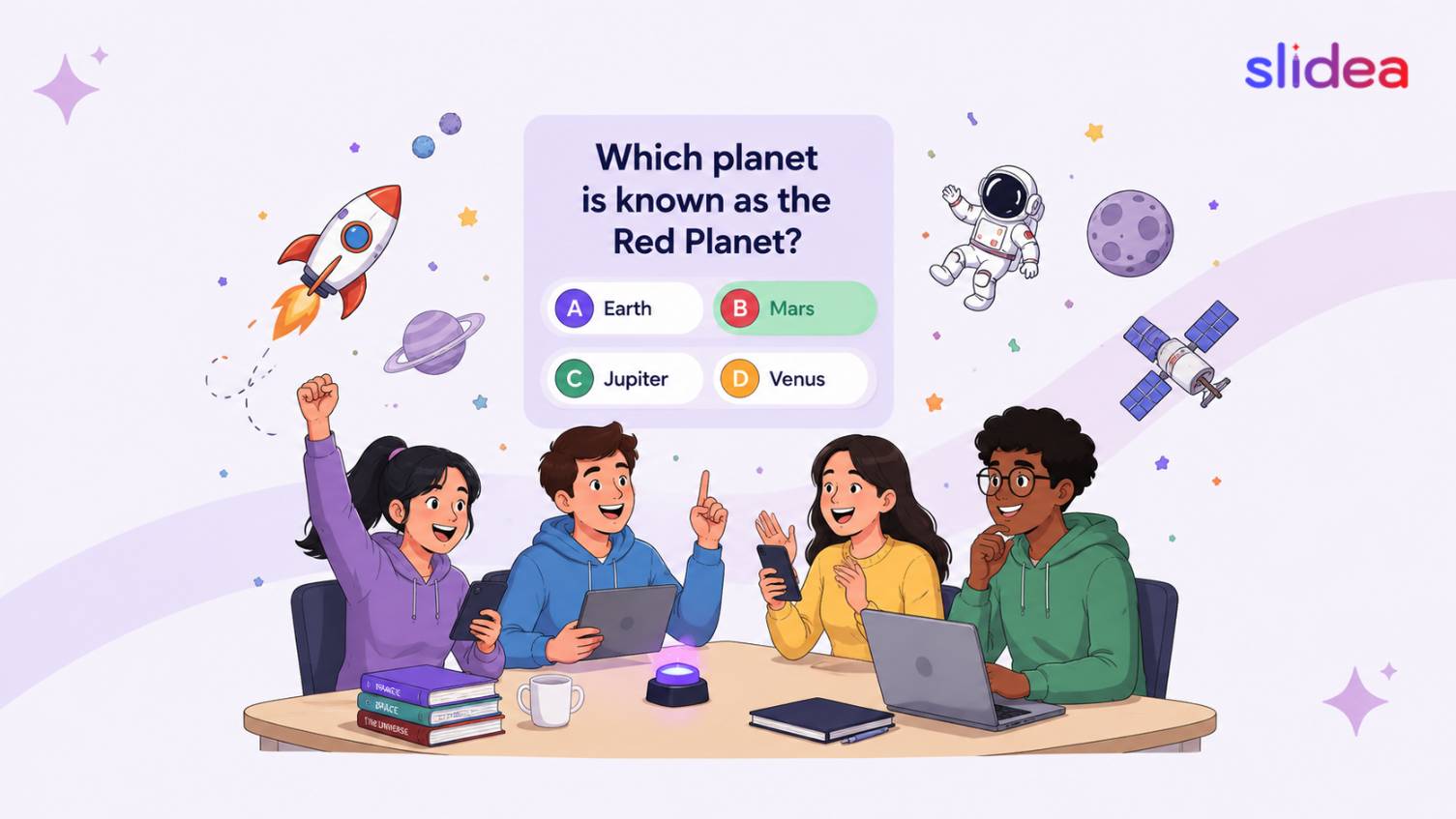
Slidea offers four distinct quiz slide types, each engaging different cognitive skills and making your World Water Day quiz more dynamic:
Select Answer (Multiple Choice): Perfect for testing recognition and understanding.
Example: “How many people worldwide lack access to safe drinking water?
A) 500 million
B) 1 billion
C) 2.2 billion
D) 4 billion.”
Students tap their choice, and results appear instantly showing how many picked each option.
This format works beautifully for questions with clear factual answers and helps visual learners process options.
Type Answer (Open Response): Requires genuine recall, not just recognition, testing deeper knowledge.
Example: “What does SDG stand for?”
Students must type the actual answer: “Sustainable Development Goals.”
Slidea’s smart recognition accepts variations in spelling and formatting, so minor typos don’t penalize students unfairly. This format eliminates lucky guessing and reveals who truly understands concepts versus who’s just good at multiple choice.
Pick the Number (Numerical Estimation): Engages mathematical reasoning and real-world estimation skills.
Example: “How many gallons does a 5-minute shower use?
Pick a number between 1-50.” Students slide a scale to their estimate, then you reveal the actual answer (10-25 gallons).
This visual, interactive format makes numerical questions more engaging than traditional multiple choice and opens discussions about why students estimated high or low.
Line Up (Sequencing and Ordering): Tests understanding of relationships, priorities, and sequences.
Example: “Arrange these by water usage from LEAST to MOST: shower, toilet, washing machine, outdoor watering.”
Students drag and drop items into the correct order.
This format is excellent for comparing water footprints, ranking conservation priorities, or ordering the water cycle steps. It requires deeper processing than simply selecting a correct answer.
After World Water Day activities, export Slidea’s results to share with parents, administrators, or even local water conservation organizations. Show your principal: “Our 5th graders improved water knowledge by 45% through interactive education!”
Some schools even create schoolwide competitions, comparing classes’ quiz performances and conservation commitments to create positive peer pressure for environmental action.
Conclusion
World Water Day offers educators a powerful opportunity to teach environmental responsibility through a resource students encounter daily but rarely think about deeply. These questions provide the content, but an interactive quiz platform like Slidea provides the delivery mechanism that transforms information into engagement, memorization into understanding, and awareness into action.
When students compete to identify conservation strategies, see their knowledge growth through pre/post assessments, collectively commit to water-saving actions via word clouds, and debate water issues in breakout discussions sparked by quiz questions, that’s when real learning happens. That’s when environmental education moves from abstract concepts to personal responsibility.
FAQs
Q1. When is World Water Day celebrated and why is it important?
World Water Day is celebrated on March 22 every year. It raises awareness about freshwater conservation and the global water crisis.
Q2. What is the main theme of World Water Day?
Each year, World Water Day has a different theme announced by the United Nations. The theme focuses on urgent global water challenges like groundwater, sanitation, or climate change.
Q3. What are some easy World Water Day quiz questions for kids?
Simple questions can include facts about the water cycle, saving water at home, and basic global water statistics. For younger students, true/false and multiple-choice formats work best.
Q4. How does World Water Day help students learn about conservation?
It encourages students to understand water scarcity and adopt water-saving habits. Activities like quizzes, poster making, and pledges make learning practical and memorable.
Q5. What is SDG 6 in relation to World Water Day?
SDG 6 stands for Sustainable Development Goal 6: Clean Water and Sanitation. It aims to ensure safe and affordable water access for everyone by 2030.






Leave a Comment
Your email address will not be published. Required fields are marked *