


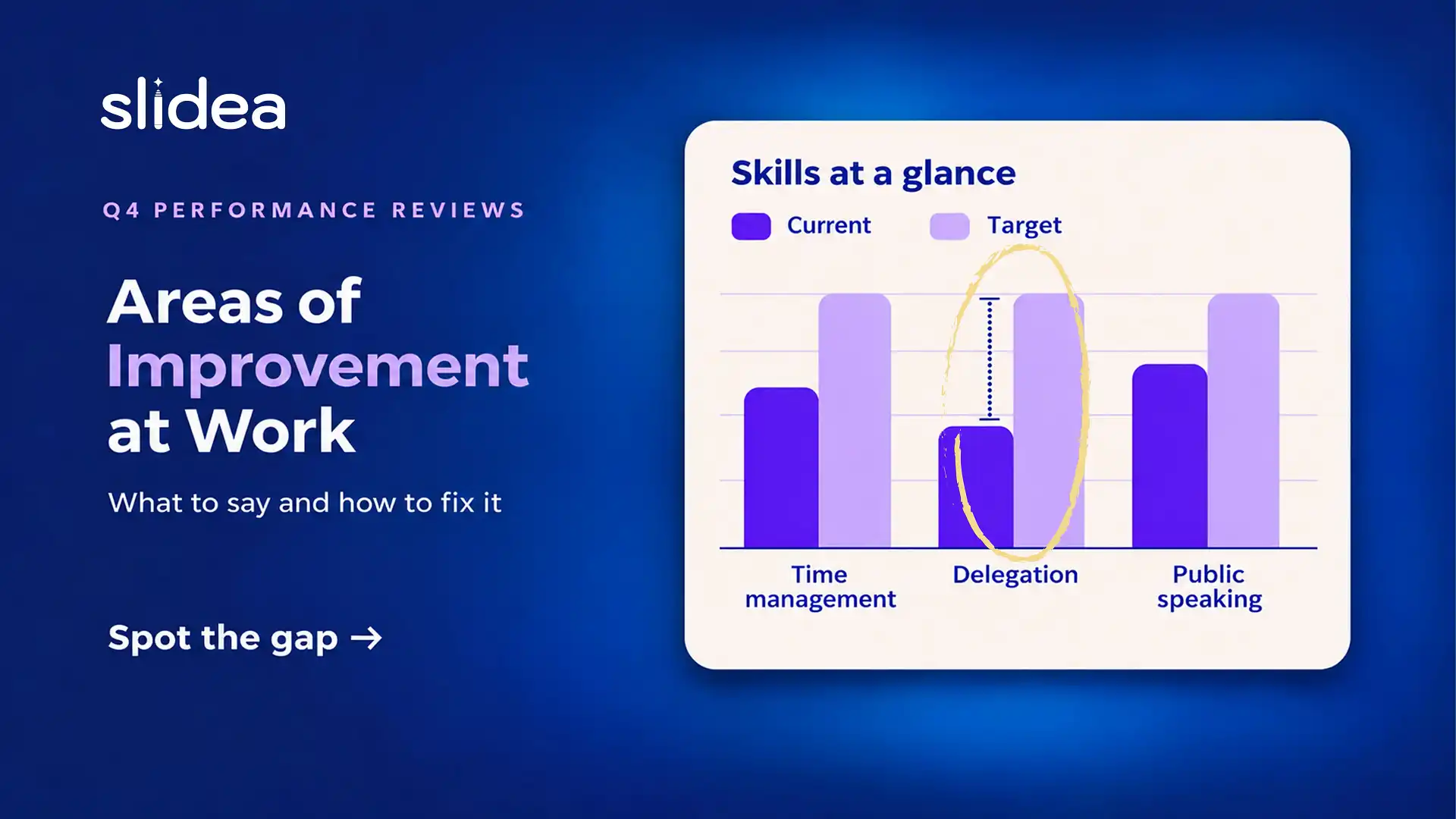
It’s acceptable for everyone to have areas of professional improvement at work. Whether you’re looking for practical things to improve on at work, phrasing for an upcoming evaluation, or ways to gather feedback through Slidea, these are the most common ones with examples for self-reviews, performance reviews and interviews. Naming yours is your own self-awareness sign.
What are Areas of Improvement?
Areas of improvement are basically the stuff you know you could do better at work and the ones that keep coming up in feedback. Working on them is how professional improvement happens. Depending on your company, managers might call them areas of improvement or areas of growth, while opportunities for improvement or areas of development are typically listed on HR forms.
15 Areas of Improvement at Work
Pick 2 or 3 that sound most like you to improve at work. Most of these are soft skills, so they get easier with practice.
| Area | Example | How to improve |
|---|---|---|
| 1. Time management | Tasks take longer than I think. | Time yourself for a week, then check where hours are wasted. |
| 2. Prioritization | I answer every request right away instead of finishing my top priority. | Pick 3 tasks each morning and do one before checking email. |
| 3. Communication | My team finds out about changes after they happen. | Send a 3-line Friday update: done, next, stuck. |
| 4. Giving feedback | I’ll fix it myself before I’ll tell someone it’s wrong. | Say it early and privately. |
| 5. Receiving feedback | My first reaction to feedback is to explain myself instead of listening. | Say “thanks,” then respond a day later. |
| 6. Delegation | It’s faster if I just do it myself. | Pick one task this month and let someone else do it, even if it’s not done your way. |
| 7. Public speaking | I’m confident one-on-one but I freeze in front of 20 people. | Start with short updates in team meetings. Then try these presentation techniques for beginners. |
| 8. Leadership | I wait to be assigned projects instead of taking ownership. | Lead one small project or meeting this quarter. |
| 9. Problem solving | I flag issues well but I don’t bring solutions with them. | Bring at least one possible fix with every problem you raise. |
| 10. Attention to detail | I let small typos slip through. | Read it out loud before you send it. |
| 11. Emotional intelligence | I don’t always notice when a teammate is stressed. | After a tense moment, check in and ask how the other person is doing. |
| 12. Conflict resolution | I avoid conflict, so disagreements go unresolved. | Raise issues privately and early, while they’re still small. |
| 13. Decision-making | I second-guess small decisions and wait for others to weigh in. | Give yourself a deadline for small calls, then decide and move on. |
| 14. Stress management | When it gets busy, my stress shows in how I talk to people. | Break big deadlines into smaller checkpoints. |
| 15. Taking initiative | I have ideas for better processes but don’t share them. | Bring one small idea to every team meeting. |
3 Key Strengths and 3 Areas of Improvement
When asked to share both sides of your performance, pair every gap with what you’re doing about it. Use this formula:
Fill in the blanks:
“I’m strong at ____, ____, and ____. I’m working on ____, ____, and ____. I’ve started ____.”
Here are strengths and areas of improvement examples for 3 roles:
How to Answer “What Areas Need Improvement?” in an Interview
When an interviewer asks about your areas of improvement, you don’t have to share your worst weakness. Choose something you’ve struggled with but are actively working on. Just make sure it isn’t a core skill you’ll need every day in the role you’re applying for.
You might say, for example, that you’re still learning to handle difficult client conversations or that you sometimes take longer to make decisions when working alone.
Avoid answers like “I have no weaknesses” or “I’m a perfectionist.” Both are overused, and neither gives the interviewer a clear idea of what you’re actually working to get better at.
Areas of Improvement Examples for Self-Reviews
A self-review gives you a chance to look at your work honestly and identify what you’d like to do better in the upcoming months. You just need a couple of specific areas of improvement, along with a realistic next step. For more, see these self-appraisal tips.
- “I sometimes take too much on myself. I’ll hand off two recurring tasks next quarter.”
- “I want to speak up earlier in meetings so I’ll share one idea at every team meeting.”
- “My updates could be more regular, so I’ll send a short progress note every Friday.”
- “I rush final checks, so small errors slip through. I’ll use a checklist before sending client work.”
- “I want to prioritize better when several urgent requests land at once. I’ll plan my week every Monday.”
Choose one or two areas to zero in on. It won’t be very helpful to list six problems in a self-review without a specific strategy to solve them.
Areas of Improvement Examples for Performance Reviews
Performance reviews provide an opportunity to talk about what’s going well and where there’s room to improve. If you need areas of improvement performance review examples, the wording will depend on whether you’re giving feedback as a manager or writing about your own performance.
Phrases for managers
- “Your work is consistently strong. Sharing progress earlier would help the team plan around it.”
- “Most deadlines are met, but a few have slipped. Let’s set midpoint check-ins on larger tasks.”
- “You bring great energy to client calls, so leaving a few extra pauses for the client to speak will help find their deep needs”
Phrases for self-reviews
- “I’ve been reactive with long-term project timelines. I’m going to break larger deliveries into weekly milestones.”
- “I want to contribute more in cross-functional meetings, so I’m preparing two talking points before every sync.”
Running team review or feedback sessions? Instead of relying on guesswork before review cycles, use Slidea to run quick, anonymous pulse checks during team syncs. Create a free anonymous poll to understand real issues and alignment gaps in minutes.
Suggestions for Improvement Examples in the Workplace
Sometimes the area of improvement is the setup, not you. When a survey or your manager asks for suggestions, frame them as fixes (never as complaints):
- “Could every meeting have a short agenda so we know what to prepare?”
- “Let’s keep project files in one shared folder.”
- “New hires would ramp up faster with an onboarding checklist.”
- “What if Wednesday mornings are meeting-free?”
- “An anonymous feedback form would help people raise concerns.”
How to Improve Work Performance
For professional improvement, start with one area. If you work on several at once, it’s hard to tell what’s helping. Give yourself a clear target too, like presenting at 2 team meetings this quarter, so you know when you’ve made progress. Ask your manager for one specific thing to work on and check in on it every month.
How to Identify Areas of Improvement on Your Team
Ask a team “what are you bad at?” in a meeting and you’ll get silence. Ask anonymously and they actually answer. With Slidea, you can run anonymous live polls during a meeting or training.
Create a free anonymous poll:
- ►Polls: “Which skill would help you most this quarter?”
- ►Rating scales: confidence from 1 to 5 in presenting or feedback.
- ►Open-ended questions: “What’s one thing that would make your work easier?”
Ask again in 3 months to see what’s changed.
FAQ
What are 3 areas of improvement I can mention?
Delegation, public speaking and time management are safe bets, and progress is easy to show.
What should I write for areas of improvement in a self-review?
One or two real areas, a short example and a specific goal.
Is it okay to say I have no areas of improvement?
No. It can sound like you lack self-awareness, while naming one shows maturity.




Leave a comment
Your email address will not be published. Required fields are marked *