


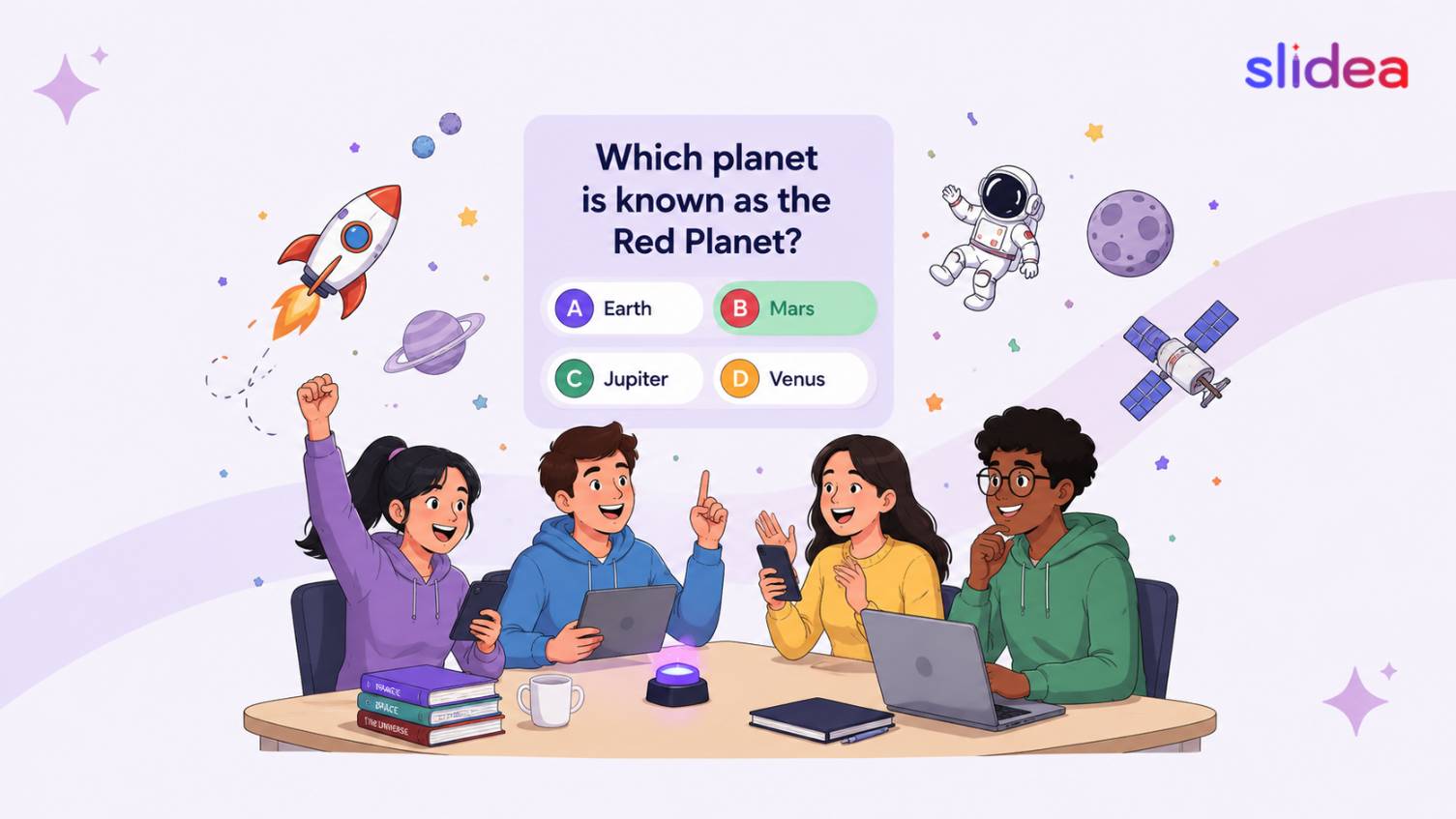
Space is one of the easiest trivia topics to get people excited about. Everyone has looked up at the night sky and wondered about it, so a good space trivia round works for kids, adults, classrooms, and quiz nights alike.
This list has over 100 space trivia questions and answers, split into easy categories: planets, stars and galaxies, NASA missions, astronauts, easy facts for younger players, and fun space records. Use it however works best for your group, read it out loud, print it, or turn it into a live scored quiz in a couple of minutes.
Why Space Trivia Works So Well for Any Group
Space trivia sits in a nice middle ground. Some questions are easy enough for kids to get right away, like the color of Mars, while others are a fun challenge for adults, like naming the largest moon in the solar system. That mix keeps everyone in the game, instead of only the "experts" scoring points.
It also fits almost any setting. Teachers use it to wrap up a science unit. Parents use it for a rainy day at home. Space fans use it before watching a space movie together. It is simple to run with nothing more than this list and a way to keep score.
Planets and the Solar System
Q: How many planets are in our solar system? A: Eight.
Q: Which planet is closest to the Sun? A: Mercury.
Q: Which planet is known as the Red Planet? A: Mars.
Q: Which is the largest planet in our solar system? A: Jupiter.
Q: Which planet is famous for its rings, visible even with a small telescope? A: Saturn.
Q: Which planet spins on its side compared to the others? A: Uranus.
Q: Which planet is often called Earth's twin because of its similar size? A: Venus.
Q: Which planet is farthest from the Sun? A: Neptune.
Q: What is Pluto classified as today? A: A dwarf planet.
Q: Which planet has the shortest day? A: Jupiter.
Q: Which planet is the hottest in the solar system? A: Venus.
Q: What is the name of the giant storm seen on Jupiter? A: The Great Red Spot.
Q: How many moons does Earth have? A: One.
Q: Where is the asteroid belt located? A: Between Mars and Jupiter.
Q: What do we call a planet that orbits a star other than the Sun? A: An exoplanet.
Q: What is the name of the belt of icy objects beyond Neptune? A: The Kuiper Belt.
Q: Which planet is known for having a day longer than its year? A: Venus.
Q: What causes Earth's seasons? A: The tilt of Earth's axis.
Q: About how long does it take Earth to orbit the Sun? A: About 365 days, or one year.
Q: What do we call the path a planet takes around the Sun? A: Its orbit.
Stars, Moons, and Galaxies
Q: What is the closest star to Earth? A: The Sun.
Q: What is the name of our galaxy? A: The Milky Way.
Q: What do we call a group of stars that forms a recognizable pattern? A: A constellation.
Q: What is the name of Earth's only natural satellite? A: The Moon.
Q: What causes a solar eclipse? A: The Moon passing between the Sun and Earth.
Q: What causes a lunar eclipse? A: Earth passing between the Sun and the Moon.
Q: What is a shooting star actually? A: A small piece of rock or dust burning up in Earth's atmosphere, also called a meteor.
Q: What is the difference between a meteor and a meteorite? A: A meteorite is a meteor that survives and lands on Earth's surface.
Q: What type of star is our Sun? A: A yellow dwarf star.
Q: What is a black hole? A: A region in space where gravity is so strong that nothing, not even light, can escape.
Q: What do we call a galaxy shaped like a spiral, like our own? A: A spiral galaxy.
Q: What is the name for the study of stars and space? A: Astronomy.
Q: What is the name for the imaginary line a planet spins around? A: Its axis.
Q: What is a supernova? A: A massive explosion that happens at the end of a large star's life.
Q: What is the name for the layer of gases surrounding a planet? A: The atmosphere.
Q: What are the colorful lights sometimes seen in the night sky near the poles called? A: The aurora, also known as the northern or southern lights.
Q: What do we call a large cloud of dust and gas in space where stars are born? A: A nebula.
Q: What do astronomers call a star that suddenly appears much brighter, then fades? A: A nova.
NASA and Space Missions
Q: What does NASA stand for? A: National Aeronautics and Space Administration.
Q: What was the name of the mission that first landed humans on the Moon? A: Apollo 11.
Q: Who was the first person to walk on the Moon? A: Neil Armstrong.
Q: What is the name of NASA's famous space telescope used to study deep space? A: The Hubble Space Telescope.
Q: What is the International Space Station usually called for short? A: The ISS.
Q: What was the name of the reusable spacecraft NASA flew for three decades? A: The Space Shuttle.
Q: Which planet have multiple NASA rovers explored on its surface? A: Mars.
Q: What are the names of the twin space probes launched to study the outer planets and beyond? A: Voyager 1 and Voyager 2.
Q: What do we call a vehicle designed to travel and explore the surface of another planet? A: A rover.
Q: What is Europe's space agency called? A: The European Space Agency, or ESA.
Q: What do we call a spacecraft that circles a planet or moon without landing on it? A: An orbiter.
Q: What do astronauts wear to survive outside a spacecraft? A: A spacesuit.
Q: What is a launch pad used for? A: Launching rockets into space.
Q: What do we call the moment a rocket leaves the ground? A: Liftoff.
Q: What is Mission Control responsible for? A: Monitoring and guiding a space mission from the ground.
Q: What do we call a spacecraft designed to carry astronauts? A: A crewed spacecraft, or capsule.
Play This List as a Ready-Made Space Quiz
You do not have to build a space quiz from scratch to run one live. Slidea already has a ready-made template called "General Knowledge About Space Trivia," with interactive questions covering planets, stars, galaxies, moons, space missions, and astronauts, the same categories covered in this list.
Open the template, and it is ready to present. Players join from their own phone using a link or a QR code, no app or account needed on their end. As the group answers, a live leaderboard updates on screen after each question. It works well for a classroom science unit, a family game night, or a space themed birthday party.
With that ready to go, here are more space questions to stock it with, starting with the people who actually go there.
Astronauts and Space Exploration
Q: What do we call a person trained to travel in space? A: An astronaut.
Q: What is the Russian term for an astronaut? A: A cosmonaut.
Q: What do astronauts feel in orbit because they are constantly falling around Earth? A: Weightlessness, also called microgravity.
Q: What kind of food do astronauts eat in space? A: Specially packaged food, often freeze dried or vacuum sealed.
Q: How do astronauts sleep in space? A: Strapped into a sleeping bag attached to a wall, since there is no up or down.
Q: What protects astronauts from the harsh conditions of space? A: Their spacesuit and the spacecraft's shielding.
Q: What is a spacewalk officially called? A: An extravehicular activity, or EVA.
Q: Who was the first woman to travel to space? A: Valentina Tereshkova.
Q: What do astronauts use to stay attached while working outside their spacecraft? A: A tether.
Q: About how long does it take to travel from Earth to the Moon? A: About three days.
Q: What must a rocket reach to break free of Earth's gravity? A: Escape velocity.
Q: What do we call the part of a rocket that falls away once its fuel is used? A: A stage.
Q: What protects a spacecraft and its crew during reentry into Earth's atmosphere? A: A heat shield.
Q: What do astronauts train underwater for? A: To get used to the feeling of weightlessness.
Q: What do we call the moment a spacecraft safely returns and touches down? A: Landing, or splashdown if it comes down in water.
Q: What do we call training exercises that prepare astronauts for a mission? A: Astronaut training, which includes simulations of the mission ahead.
Fun and Easy Space Facts
Q: About how many days does it take the Moon to orbit Earth? A: About 27 days.
Q: What color does Mars usually appear? A: Red, or a reddish orange.
Q: What is the biggest object in our solar system? A: The Sun.
Q: Can you hear sound in space? A: No, because space has no air for sound to travel through.
Q: What force keeps planets moving around the Sun? A: Gravity.
Q: What do we call a rock from space that lands on Earth? A: A meteorite.
Q: How many stars can you usually see in the night sky without a telescope? A: Only a few thousand at most, even though there are far more stars than that in total.
Q: What is the name of the United States space agency? A: NASA.
Q: Which is bigger, the Sun or the Earth? A: The Sun, by a huge amount.
Q: What do we call someone who studies stars and planets as a job? A: An astronomer.
Q: What are conditions like in space, temperature wise? A: Extremely cold, away from direct sunlight.
Q: Why do astronauts float inside a spacecraft in orbit? A: Because they are constantly falling around Earth along with their spacecraft, which feels like weightlessness.
Q: What was the name of the first artificial satellite launched into space? A: Sputnik 1.
Q: What shape are most planets? A: Roughly spherical, or round.
Q: What is moonlight actually made of? A: Sunlight reflecting off the surface of the Moon.
Q: What do we call the study of objects beyond Earth's atmosphere? A: Astronomy, or more broadly, space science.
Space Records and Numbers
Q: About how many Earths could fit inside the Sun? A: About one million.
Q: About how long does it take sunlight to reach Earth? A: About eight minutes.
Q: What do we call the average distance from Earth to the Sun? A: An astronomical unit.
Q: How many known planets are there in our solar system? A: Eight.
Q: How many days are in a year on Earth? A: 365 days, or 366 in a leap year.
Q: About how long is a year on Mars compared to Earth? A: Almost twice as long, about 687 Earth days.
Q: What is the largest moon in our solar system? A: Ganymede, a moon of Jupiter.
Q: About how fast does light travel? A: About 300,000 kilometers per second.
Q: What do we call the layer of Earth's atmosphere where most weather happens? A: The troposphere.
Q: About how old is our solar system estimated to be? A: About 4.6 billion years old.
Q: Which planet is the coldest in our solar system? A: Neptune, though Uranus comes close.
Q: What is the name of the boundary often used to mark where space begins? A: The Karman line.
Q: What is the tallest known mountain in the solar system, found on Mars? A: Olympus Mons.
Q: What is the largest known canyon in the solar system, found on Mars? A: Valles Marineris.
Q: About how long does it take a radio signal to travel between Mars and Earth? A: Several minutes, depending on how far apart the two planets are at the time.
Q: What do we call the point in an orbit that is closest to the Sun? A: Perihelion.
Tips for Running a Great Space Trivia Round
Start easy, then go harder. Open with simple questions like planet colors or basic facts, then move into NASA missions and space records as the round goes on.
Group by category. Players enjoy knowing what kind of question is coming next, and it keeps the round easy to follow.
Set a time limit per question. Ten to fifteen seconds keeps the pace moving and works well for both kids and adults.
Mix age groups into teams. Space trivia has a wide range of difficulty, so pairing a space fan with a beginner keeps every team competitive.
Pull in a visual if you can. A picture of a planet or a real NASA photo alongside a question makes the round more memorable, especially for younger players.
FAQ
Where can I find good space trivia questions for kids? The "Fun and Easy Space Facts" and "Planets and the Solar System" sections above are a good starting point, since they cover simple, well known facts that most kids pick up quickly.
How many space trivia questions do I need for a classroom activity? Twenty to thirty questions is usually enough for a 15 to 20 minute classroom activity. This list gives you more than enough to build a few different rounds.
Is space trivia good for adults too, or just kids? Both. The planet and easy fact questions work well for kids, while the NASA missions, astronaut, and space records questions give adults a real challenge.
Can I turn this list into a live quiz game? Yes. Slidea has a ready-made "General Knowledge About Space Trivia" template that covers planets, stars, galaxies, moons, space missions, and astronauts as a scored quiz with a live leaderboard, which players join from their own phone using a link or QR code.
What is a good way to theme a space trivia night? Pair it with a space movie, a planetarium visit, or a school science unit. A themed backdrop or simple decorations can make the round feel like a bigger event.
How do I keep score for a big group playing space trivia? For a small group, a simple tally on paper works. For a bigger group, a live scored quiz tool tracks points automatically and shows a leaderboard on screen, so nobody has to count by hand.
Ready to Play It Live?
A great list of space trivia questions is even better with a live leaderboard behind it. Try Slidea's ready made space trivia template and run it with your next class, family, or group of friends – free to start.








Your email address will not be published. Required fields are marked *