



A teacher once asked her class of 30 students a simple question, "What would the world look like if there were no rules?" Within seconds, hands shot up across the room. Students who never usually spoke were leaning forward, bursting to share their thoughts. The discussion ran for 20 minutes without the teacher saying a single word.
That's the power of one good open-ended question in a classroom. Most classroom discussions stay quiet because the questions asked have only one right answer. Students either know it or they don't. And when they don't, they stay silent. But open-ended questions are completely different. There is no single right answer. Every student has something valid to say. And that changes everything about how a classroom feels.
Open-ended questions build critical thinking, spark creativity, and create real student-to-student conversations that go far beyond the textbook. And when you run them through a smart interactive classroom platform, every student gets a voice, not just the confident few who always raise their hands.
In this blog, you will find 50 open-ended questions sorted across five subject-based categories, all designed to make your classroom discussions more engaging, more inclusive, and a whole lot more exciting.
Open-Ended vs Closed-Ended Questions in the Classroom
Understanding the difference between these two question types is key to improving classroom discussions.
| Aspect | Open-Ended Questions | Closed-Ended Questions |
| Definition | Have no single correct answer | Have one correct or limited answer |
| Purpose | Encourage thinking, explanation, and creativity | Focus on facts, recall, or quick responses |
| Response Type | Detailed, descriptive answers | Short answers like “yes,” “no,” or a word |
| Discussion | Invite discussion and multiple perspectives | Limit discussion and deeper thinking |
| Example | “Why do you think the character made that decision in the story?” | “Did the character make the right decision?” |
Open-Ended Questions That Make Classroom Discussions More Engaging
Category 1: English and Literature Questions
These questions get students thinking about stories, language, characters, and the power of words.
- Why do you think storytelling is one of the oldest human traditions?
- What makes a character in a book feel real and relatable to you?
- How does the language an author uses change the way you feel about a story?
- What do you think a story can teach us that a textbook cannot?
- If you could rewrite the ending of any book you have read, what would you change and why?
- How does poetry say things differently from regular writing, and why does that matter?
- What do you think makes a piece of writing truly powerful?
- If a character in a book made a different choice at the key moment, how do you think the story would change?
- Why do you think some stories last for hundreds of years while others are quickly forgotten?
- What is the most important thing a book has ever made you feel or understand about yourself?
Category 2: Science and Nature Questions
These prompts get students curious about the world around them and how things work.
- Why do you think it is important for humans to understand how nature works?
- What do you think would happen to life on Earth if the oceans disappeared?
- How do you think science has changed the way people live compared to 100 years ago?
- What is one environmental problem you care about most, and what do you think could fix it?
- Why do you think some animals have gone extinct while others have survived for millions of years?
- How do you think space exploration affects life here on Earth?
- What do you think the world would look like if humans had never discovered electricity?
- Why do you think it is so hard for people to change their habits even when they know something is bad for the environment?
- What is one scientific discovery that you think changed the world the most?
- How do you think technology and nature can work together instead of against each other?
You can also make science discussions more interactive by using Earth Day quiz questions or exploring Earth Hour quiz questions to spark meaningful conversations about the environment.
Category 3: Social Studies and History Questions
These questions connect the past to the present and help students think about society in a deeper way.
- Why do you think it is important to study history even when it is painful or difficult?
- What do you think makes a leader truly great, and can you think of someone who fits that description?
- How do you think the lives of people your age were different 100 years ago?
- What do you think would happen if every country in the world had the same rules and laws?
- Why do you think some communities grow and thrive while others struggle?
- How has immigration shaped the culture and identity of countries around the world?
- What do you think is the biggest lesson history teaches us about conflict and peace?
- How do you think the role of women in society has changed over the last century, and what caused those changes?
- What do you think would be different about the world today if a key historical event had never happened?
- Why do you think some people resist change even when that change seems positive for everyone?
To take discussions even further, explore the short debatable topics for classroom discussions that encourage students to think critically and share different perspectives.
Category 4: Math and Critical Thinking Questions
These questions show students that math is not just about numbers, it is about thinking clearly and solving real problems.
- Why do you think math is considered a universal language that everyone in the world can understand?
- How do you think math is used in everyday life in ways that most people don't notice?
- What do you think would change about the world if we had no way to measure time?
- How do you think patterns in math connect to patterns we see in nature and art?
- Why do you think some people find math scary, and what do you think could change that?
- If you could solve one real-world problem using math, what problem would you pick?
- How do you think the way we use numbers and data affects the decisions governments and businesses make?
- What do you think makes a solution to a problem truly elegant or beautiful?
- How do you think logical thinking helps people outside of a math classroom?
- Why do you think it is important to show your working, not just your answer?
Category 5: Life Skills and Personal Growth Questions
These questions help students reflect on who they are, how they treat others, and what kind of person they want to become.
- What do you think is the most important quality a person can have, and why?
- How do you think the way you treat others affects the way you feel about yourself?
- What is one challenge you have faced that made you stronger in the end?
- Why do you think it is so hard to say sorry, and what makes a real apology meaningful?
- How do you think social media is changing the way young people see themselves and the world?
- What does it mean to you to be a good friend, and how do you try to be that person?
- Why do you think some people give up on their goals while others keep going no matter what?
- What is one thing you believe strongly right now that you think might change as you get older?
- How do you think kindness can change a school, a community, or even a whole country?
- If you could teach every student in the world just one lesson about life, what would it be?
To warm up quieter classrooms, try the icebreaker questions for teachers that help students feel comfortable sharing from the start.
How Slidea Makes Classroom Discussions Come Alive
Asking a great open-ended question is a powerful start. But getting every student in the classroom to respond, that’s where things often fall apart. Some students speak often. Others stay silent. That gap can limit real learning.
Slidea, an interactive classroom platform, changes that completely. It helps every student take part, not just the confident ones. Even quiet and shy students get a simple way to share their thoughts.
Here’s how Slidea supports open-ended discussions in a natural and engaging way:
Open-Ended Responses in Real Time
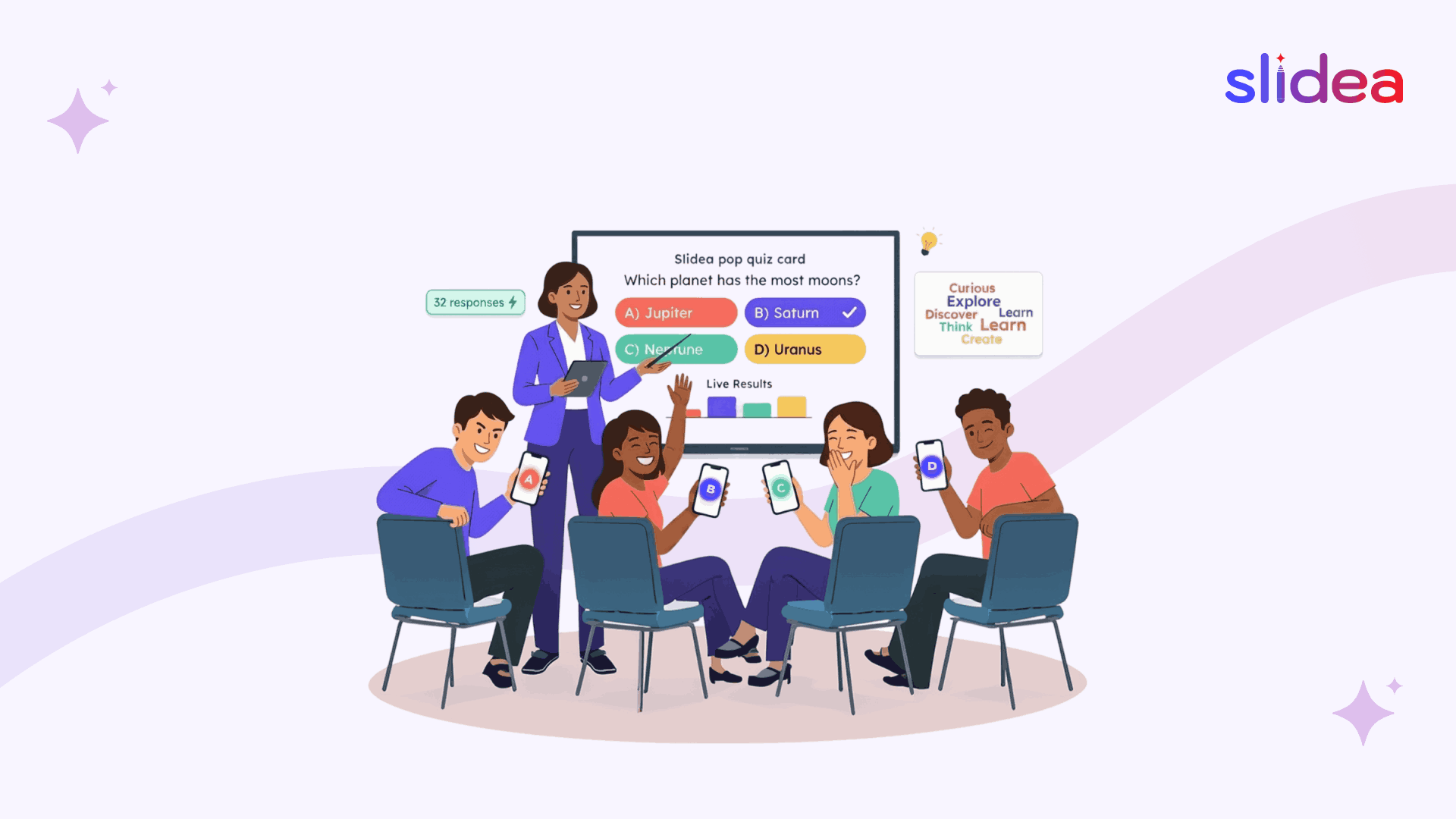
This is the most powerful tool for running open-ended questions in a classroom. You can display your question on the screen, and every student types their answer from their own device. As responses come in, they appear live on the screen one by one.
Students can read each other’s answers, compare ideas, and build on different perspectives. This creates a real discussion environment where learning happens through shared thinking.
No one has to raise their hand. No one feels pressure to speak out loud. Every student participates at the same time, which makes discussions more inclusive and balanced.
It also helps teachers quickly understand how students are thinking, not just what they know.
Word Cloud for Quick Idea Capture
Before moving into detailed answers, you can ask students to share a single word or short phrase. Their responses form a live word cloud on the screen, where common ideas appear larger.
This is a great way to warm up thinking, highlight key themes, and get everyone involved quickly. It prepares students for deeper open-ended responses.
Live Polls to Start the Conversation
You can also begin with a simple poll to understand student opinions before asking a big question. Students vote instantly, and the results appear live on screen.
This creates a shared starting point and makes students more ready to explain their thoughts during the discussion that follows.
Remote Participation Made Easy
Students can join from anywhere using a phone, tablet, or laptop. This makes it perfect for virtual classrooms and hybrid learning. Every student gets the same chance to participate, no matter where they are.
Final Thoughts on Classroom Open-Ended Questions
One good question can change an entire classroom. It can turn silence into discussion, ideas into learning, and students into active participants. Open-ended questions give every student a chance to think, speak, and connect in their own way.
When you combine these questions with a simple and powerful tool like Slidea, the impact becomes even stronger. Every student gets a voice. Every idea gets seen. And every class becomes a space where real learning happens through conversation, not just answers.
Classroom Open-Ended Questions FAQs
Q1. What are open-ended questions in the classroom?
Open-ended questions are questions that do not have a single correct answer. They encourage students to think deeply, explain their ideas, and share different perspectives.
Q2. Why are open-ended questions important for students?
They help develop critical thinking, creativity, communication skills, and confidence by allowing students to express their own thoughts freely.
Q3. How do open-ended questions improve classroom discussions?
They create more participation, encourage debate, and lead to meaningful conversations instead of short, one-word answers.
Q4. Can open-ended questions be used in online classes?
Yes, they work extremely well in online and hybrid classes, especially when paired with interactive tools that allow all students to respond in real time.
Q5. What is the difference between open-ended and closed-ended questions?
Open-ended questions allow multiple answers and deeper thinking, while closed-ended questions focus on specific, correct responses and quick recall.





Your email address will not be published. Required fields are marked *