



Curiosity is one of the strongest ways people learn new things. Most of the time, curiosity begins when someone asks an interesting question. A good science trivia question can do exactly that. It makes people pause for a moment, think about what they know, and feel excited to discover the answer.
Think about the last time someone asked you a question that made you stop and think. Not a test question or a work question, but a fascinating question about how the world works. That small moment of curiosity is what science is built on.
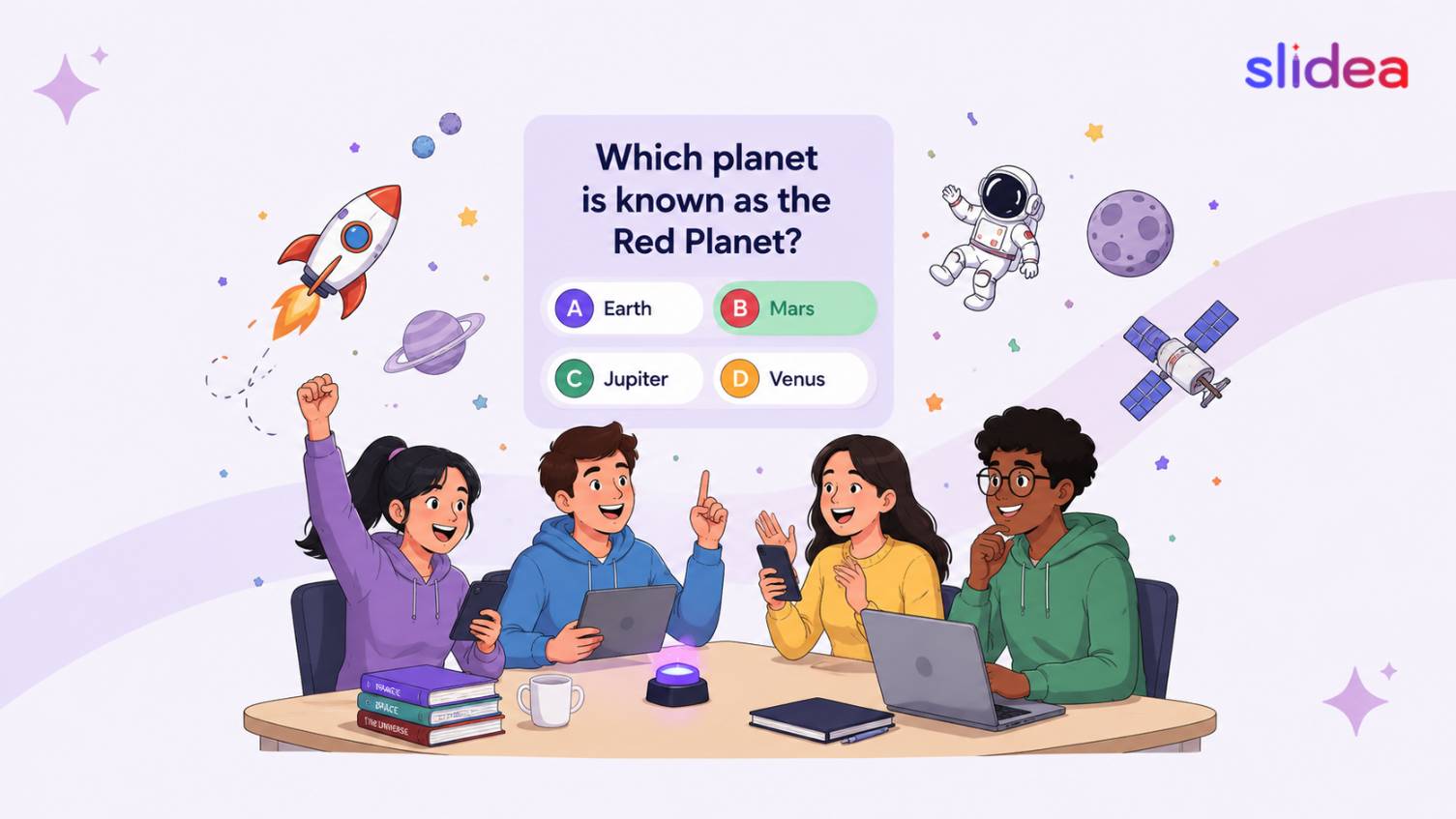
If you are a teacher who wants to make lessons more engaging, a trivia host preparing questions for an event, or someone who enjoys learning new facts, science trivia can be a great way to spark interest. When these questions are used with interactive presentation software, participants can answer in real time, see results instantly, and enjoy a more engaging quiz experience.
In this guide, you will find 60 science trivia questions with answers, organized into categories so it is easy to choose the right question for different activities, quizzes, or learning sessions.
Biology — The Science of Life
1. What is called the powerhouse of the cell?
Answer: Mitochondria. They produce most of the cell’s energy.
2. How many chromosomes are in a normal human cell?
Answer: 46 chromosomes, arranged in 23 pairs.
3. Which blood type is known as the universal donor?
Answer: O negative (O−) because it can be given to most people.
4. What is the longest bone in the human body?
Answer: The femur, also called the thigh bone.
5. What pigment gives plants their green color?
Answer: Chlorophyll, which helps plants use sunlight to make food.
6. How many hearts does an octopus have?
Answer: Three hearts.
7. What is the largest organ in the human body?
Answer: The skin, which covers and protects the body.
8. What is the basic unit of heredity?
Answer: A gene, a part of DNA that carries instructions for traits.
9. Which part of the brain controls balance and coordination?
Answer: The cerebellum.
10. What gas do plants take from the air during photosynthesis?
Answer: Carbon dioxide (CO₂).
Physics — The Laws That Run the Universe
11. What is the speed of light in a vacuum?
Answer: About 299,792,458 meters per second.
12. What does Einstein’s equation E = mc² mean?
Answer: Energy and mass are related. Mass can be turned into energy.
13. What is Newton’s first law of motion?
Answer: An object stays still or keeps moving unless a force changes it.
14. What are the three common states of matter?
Answer: Solid, liquid, and gas.
15. What force keeps planets moving around the Sun?
Answer: Gravity.
16. What is absolute zero?
Answer: The lowest possible temperature, −273.15°C.
17. What type of wave is sound?
Answer: A mechanical wave that needs a medium like air to travel.
18. What is the SI unit of electric current?
Answer: Ampere (A).
19. Why does the sky look blue?
Answer: Because blue light spreads more in the atmosphere.
20. What is the half-life of a radioactive substance?
Answer: The time it takes for half of the atoms to decay.
Chemistry — Matter, Molecules, and Reactions
21. What is the chemical symbol for gold?
Answer: Au
22. What gas makes up most of Earth’s atmosphere?
Answer: Nitrogen
23. What is the pH of pure water?
Answer: 7 (neutral).
24. What is the atomic number of carbon?
Answer: 6
25. What is the chemical formula for table salt?
Answer: NaCl
26. Which element is most common in the universe?
Answer: Hydrogen
27. What type of bond shares electrons between atoms?
Answer: Covalent bond
28. What process separates liquids with different boiling points?
Answer: Distillation
29. What gas forms when an acid reacts with a carbonate?
Answer: Carbon dioxide (CO₂)
30. How many elements are on the periodic table?
Answer: 118 elements
Astronomy — Exploring Space
31. How many planets are in our solar system?
Answer: 8 planets
32. What is the closest star to Earth after the Sun?
Answer: Proxima Centauri
33. What is a light-year?
Answer: The distance light travels in one year.
34. What galaxy do we live in?
Answer: The Milky Way
35. What causes a solar eclipse?
Answer: The Moon moves between Earth and the Sun.
36. What is the Great Red Spot on Jupiter?
Answer: A very large storm on the planet.
37. What is a black hole?
Answer: A place in space with extremely strong gravity.
38. Which planet has the most moons?
Answer: Saturn
39. What was the first artificial satellite?
Answer: Sputnik 1
40. What does the Hubble constant measure?
Answer: How fast the universe is expanding.
Earth Science — Our Planet
41. What are the four layers of the Earth?
Answer: Crust, mantle, outer core, inner core
42. What is the most common rock on the ocean floor?
Answer: Basalt
43. What causes earthquakes?
Answer: Movement of tectonic plates.
44. What is another name for the water cycle?
Answer: Hydrological cycle
45. What does the Richter scale measure?
Answer: Earthquake strength.
46. What was the ancient supercontinent called?
Answer: Pangaea
47. How much of Earth’s surface is covered by water?
Answer: About 71%
48. What is the main greenhouse gas linked to climate change?
Answer: Carbon dioxide
49. What rock forms from cooled magma or lava?
Answer: Igneous rock
50. What does the ozone layer protect us from?
Answer: Harmful ultraviolet (UV) rays from the Sun.
General Science — Mixed Topics
51. What is the scientific method?
Answer: A step-by-step way to study and test ideas.
52. Who introduced the theory of evolution by natural selection?
Answer: Charles Darwin
53. What does DNA stand for?
Answer: Deoxyribonucleic acid
54. What tool measures air pressure?
Answer: Barometer
55. What is the difference between a hypothesis and a theory?
Answer: A hypothesis is a testable idea, while a theory is a well-supported explanation.
56. What is a catalyst?
Answer: A substance that speeds up a chemical reaction.
57. Who invented the telephone?
Answer: Alexander Graham Bell
58. What is Schrödinger’s cat?
Answer: A thought experiment used to explain quantum physics.
59. What is the difference between bacteria and viruses?
Answer: Bacteria are living cells, but viruses need a host cell to reproduce.
60. What is bioluminescence?
Answer: Light produced by living organisms, such as fireflies.
What Happens When You Use These Questions at a Live Event
In many quiz nights or classroom activities, the host asks a question, and only a few people answer. The rest of the group often stays quiet, and the excitement fades quickly.
When you use interactive presentation tools, the experience becomes much more engaging. The host shows a question on the screen, and every participant can answer using their phone. Within seconds, everyone can see the responses, react together, and enjoy the moment as a group.
Here is how science trivia can work during a live event when you use an interactive tool like Slidea:
Word Cloud
Before starting the quiz, ask participants to type one word they connect with science. Words like space, DNA, experiments, or technology appear on the screen. Popular words grow larger as more people type them, creating a fun and shared starting point.
This or That
Show two choices on the screen, such as “Space exploration or ocean research?” or “Biology or physics?”. Participants tap their choice on their phones, and the results appear instantly. People enjoy seeing how the room is divided.
Live Poll
You can also run a quick poll. Ask a question and let everyone vote from their phone. As the votes appear on the screen, participants see how opinions change and start discussing the results.
Open-Ended Responses
Some people prefer typing their answers instead of speaking in front of a group. Open-ended slides allow participants to send their ideas privately from their phones. All responses appear on the main screen so everyone can read and learn from them.
Guess the Number
Add a fun number question like “How many bones are in the human body?” or “How far is the Moon from Earth?” Participants enter their guesses, and the closest answer wins. This creates excitement and curiosity at the same time.
Participants can join the activity by scanning a QR code or using a short link. No app download or account is needed. This makes it easy for people to participate during school events, corporate meetings, workshops, or community quizzes.
With the right questions and interactive tools, the screen becomes the center of the activity, and everyone in the room gets involved in the learning and fun.
Final Thoughts
A great trivia session is not just about asking questions. It works best when people feel curious and excited to take part. That feeling starts with the first question you ask.
The 60 questions in this list can help you start a fun and engaging quiz. But the real excitement comes when everyone in the room gets a chance to answer, not just a few people who speak first. When more people join in, the activity becomes more enjoyable and memorable.
Start with simple and fun questions to warm up the group. As people become more comfortable, you can move to more interesting or challenging questions. Step by step, the quiz builds energy and brings people together.
Most participants will not remember every answer, but they will remember the fun, laughter, and shared experience of the quiz. That is what makes a trivia session truly successful
FAQs
Q1. What are good science trivia questions for beginners?
Simple questions work best for beginners. For example, questions like “What is the powerhouse of the cell?” or “Why does the sky look blue?” are easy to understand and help people learn new facts.
Q2. How can you run a science trivia quiz for a large group?
For big groups, it is helpful to use interactive presentation software like Slidea. Participants can answer questions from their phones at the same time, and the results appear instantly on the screen.
Q3. Which science trivia categories are best for mixed audiences?
Categories like biology, astronomy, and general science are great for mixed groups. These topics are easy to relate to and interesting for people of different ages.
Q4. How do science trivia questions help people learn?
Trivia makes people think about what they know. When someone tries to remember an answer, it helps them understand and remember the information better.
Q5. Where can science trivia questions be used?
Science trivia questions work well in classrooms, workshops, team-building events, quiz nights, and online meetings. They make learning fun and encourage everyone to participate.







Leave a Comment
Your email address will not be published. Required fields are marked *